Posts Tagged Solar
Sun Mosaic Application with Claude Code
Posted by jmeriaux in Astrophotography, Sun on September 13, 2026
I used to rely on Photoshop to create Sun mosaics — building the layers and masks needed for H-alpha processing, a multi-step process.
I built SunMosaic, an application for processing solar mosaics, using Claude Code — and Photoshop is no longer part of my solar imaging pipeline. Importantly, it doesn’t just assemble the panels into a mosaic: it also separates the solar disc from the surrounding prominences into their own layers and a mask, so each can be processed independently — which is what makes the rest of the workflow, below, possible.
I would like to share it “as is” as an open source project: github.com/m42cococa/SunMosaic.
A ready-to-run .dmg installer is available here — Apple Silicon Macs only. It also runs as a local browser app (Streamlit) or from the command line for anyone who wants to script it.
How the pipeline works
Each panel of a mosaic starts life as a 16-bit video captured through the rig. From there:
- Stack each panel with AutoStakkert!4 to produce a sharpened per-panel TIFF.
- Feed the stacked panels into SunMosaic, which detects the solar limb on each frame, cross-correlates the overlapping regions, solves the global alignment, corrects for the uneven brightness typical of H-alpha etalon imaging, and blends the panels into a single mosaic. Beyond the flattened image, it also generates separate layers and a mask that isolate the solar disc from the surrounding prominences, so each part of the image can be adjusted independently downstream.
- Finish the mosaic in Affinity Photo 2 (free software now), using the disc and prominence layers and mask SunMosaic exports to fine-tune each independently before flattening the final image.
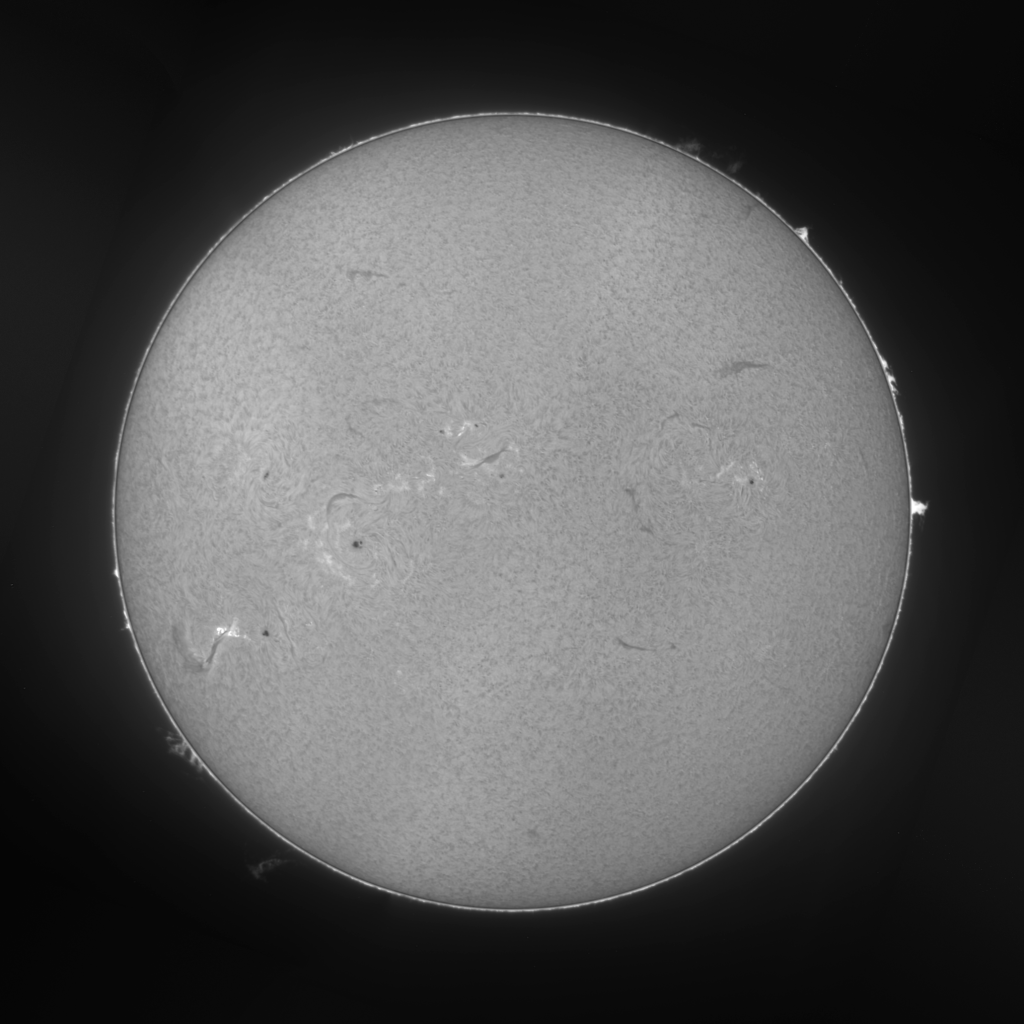
Example: September 8, 2026 mosaic
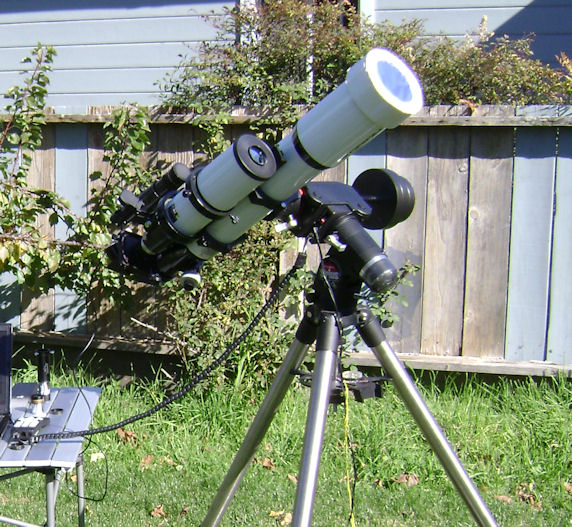
Here’s a mosaic captured on September 8, 2026 at 20:38 UTC, built from 4 panels stacked from about 500 frames each, using the same rig described in my previous post — William Optics 60mm refractor, Daystar Quark H-alpha filter, and ZWO ASI 432MM camera.

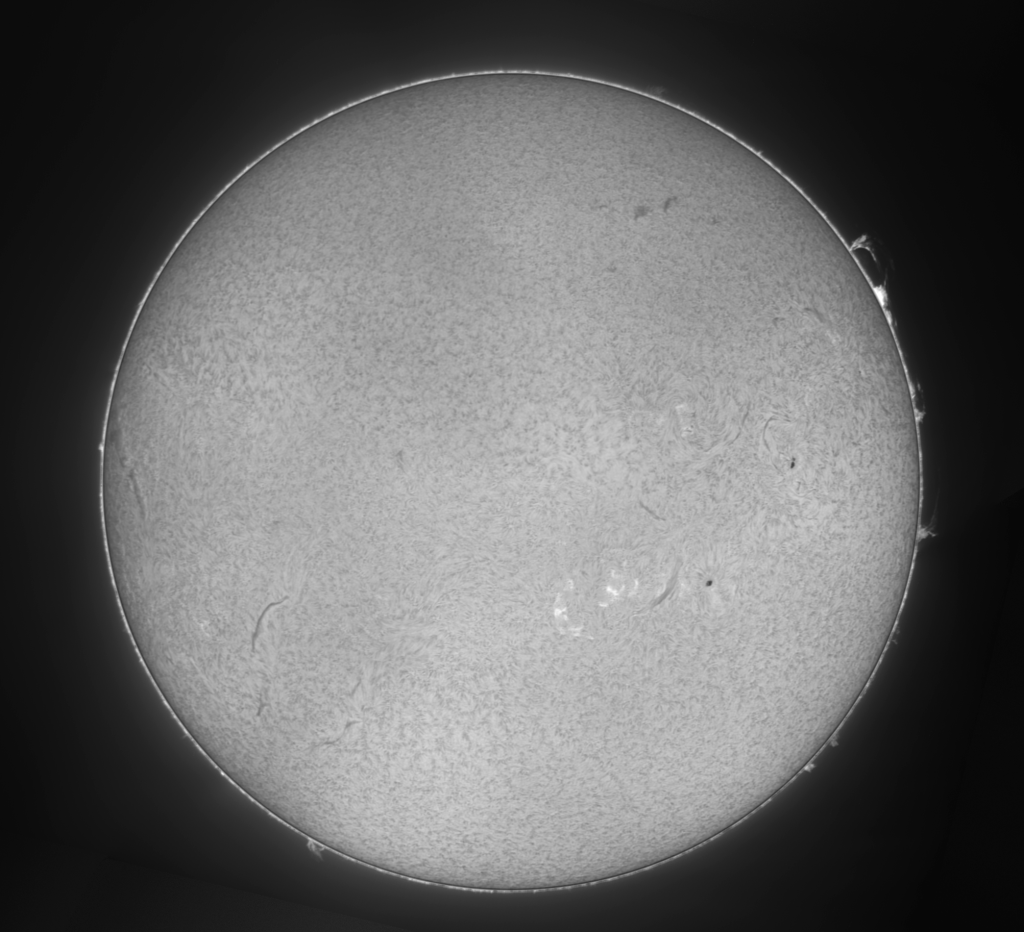
Another example: September 13, 2026 mosaic
Captured on September 13, 2026 at 20:29 UTC, same rig and pipeline.
Sun Observation – 2026-05-24
Posted by jmeriaux in Astrophotography, Sun on May 25, 2026
Taken at 20:05 UTC on 24th of May 2026.
Captured in H-Alpha using my William Optics 60mm refractor with a Daystar Quark filter and a ZWO ASI 432MM camera. The final image is a mosaic of 4 panels, each stacked from about 500 frames.

Solar astrophotography
Posted by jmeriaux in Astrophotography, Sun on November 26, 2008
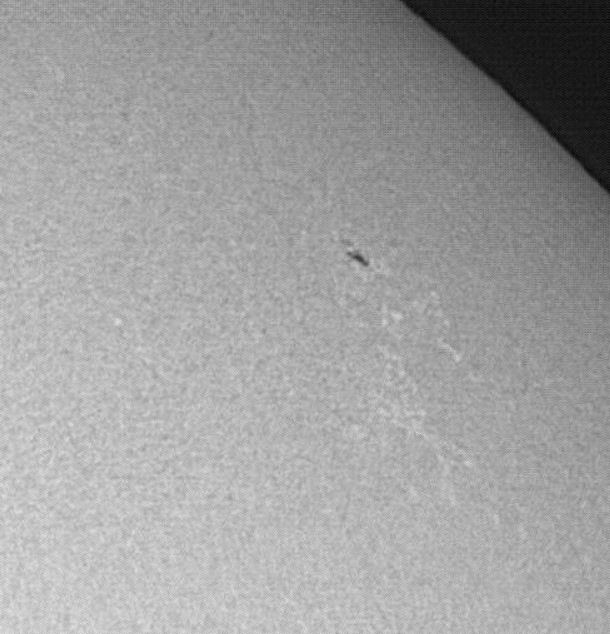
With the home made solar filter I made with the baader solar film I took some pictures of the sun, with my Orion StarShoot Solar System Imager II and the Orion 102 premium refractor on the 11/15/208 at 11.15 am PST.
Solar activity is not great these days, making things more challenging … I can remember days where giant sunspot complex where visible with the naked eye.
Shooting the Sun with a Solar filter is not an easy task. Dust speckles on the digital camera show up as you can see here on the below picture – at the right of the sun spot.
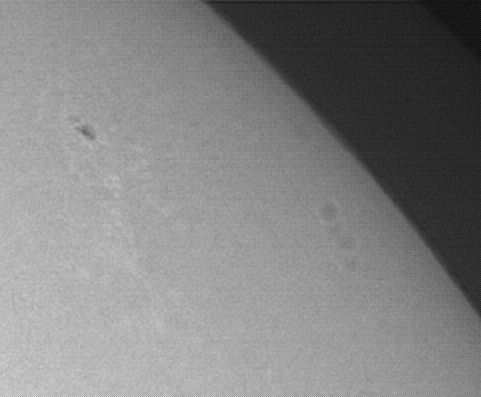
It is critical to take flat field pictures and use software like Max DSLR to substract the flat field image from the Sun spot pictures to get higher quality images.
After image processing here is the result. Notice the granulae, sun spot, and faculae around the (small) Sun spot.
Home made solar filter using Baader Solar Film
Posted by jmeriaux in Do it yourself on November 20, 2008
I had for some time the Orion 102ED premium refractor – and I was not able to find any ready made solar filter in the market to fit this scope including at the Orion’s stores.
I finally decided to buy a Baader solar filter film to build a solar filter. I ordered the baader solar filter film (A4 size) at the scope city web site.
I followed the instruction posted on the Baader planetarium web site. I was very pleased with the result – the visual observation exceeds whatever I saw with glass filters on same or larger scopes and this for one fourth of the price I paid for glass filters!! . I had also extra film left to build filters for my guide scope and finder scope.
I bought the Visual solar film (it comes in two flavors – for visual observation and for Astrophotography). But I was able to use the visual solar film for both visual observation and astrophotography. I’ll post solar pictures I made with this setup very soon.
Here is a picture of the whole setup – the 102ED premium refractor and home made solar filter with the Baader solar film …