Archive for category Sun
Sun Mosaic Application with Claude Code
Posted by jmeriaux in Astrophotography, Sun on September 13, 2026
I used to rely on Photoshop to create Sun mosaics — building the layers and masks needed for H-alpha processing, a multi-step process.
I built SunMosaic, an application for processing solar mosaics, using Claude Code — and Photoshop is no longer part of my solar imaging pipeline. Importantly, it doesn’t just assemble the panels into a mosaic: it also separates the solar disc from the surrounding prominences into their own layers and a mask, so each can be processed independently — which is what makes the rest of the workflow, below, possible.
I would like to share it “as is” as an open source project: github.com/m42cococa/SunMosaic.
A ready-to-run .dmg installer is available here — Apple Silicon Macs only. It also runs as a local browser app (Streamlit) or from the command line for anyone who wants to script it.
How the pipeline works
Each panel of a mosaic starts life as a 16-bit video captured through the rig. From there:
- Stack each panel with AutoStakkert!4 to produce a sharpened per-panel TIFF.
- Feed the stacked panels into SunMosaic, which detects the solar limb on each frame, cross-correlates the overlapping regions, solves the global alignment, corrects for the uneven brightness typical of H-alpha etalon imaging, and blends the panels into a single mosaic. Beyond the flattened image, it also generates separate layers and a mask that isolate the solar disc from the surrounding prominences, so each part of the image can be adjusted independently downstream.
- Finish the mosaic in Affinity Photo 2 (free software now), using the disc and prominence layers and mask SunMosaic exports to fine-tune each independently before flattening the final image.
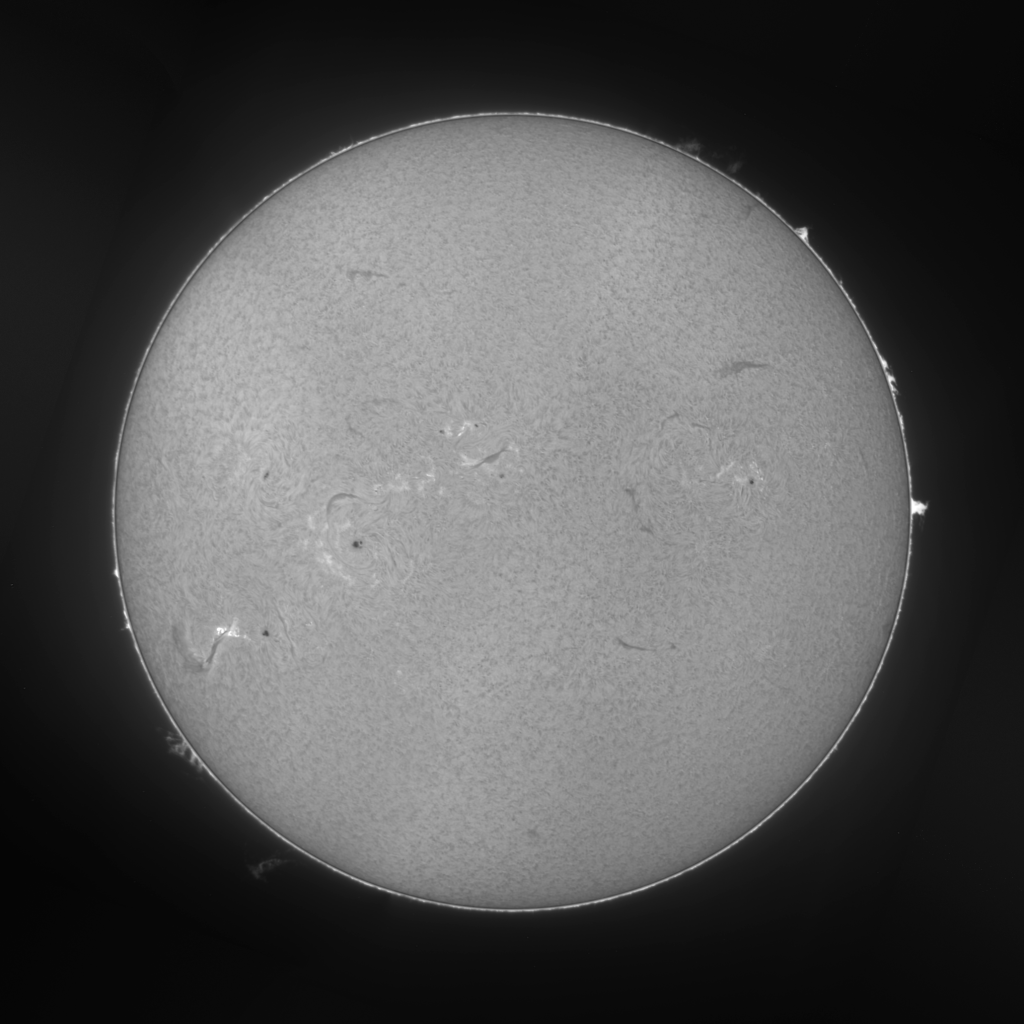
Example: September 8, 2026 mosaic
Here’s a mosaic captured on September 8, 2026 at 20:38 UTC, built from 4 panels stacked from about 500 frames each, using the same rig described in my previous post — William Optics 60mm refractor, Daystar Quark H-alpha filter, and ZWO ASI 432MM camera.

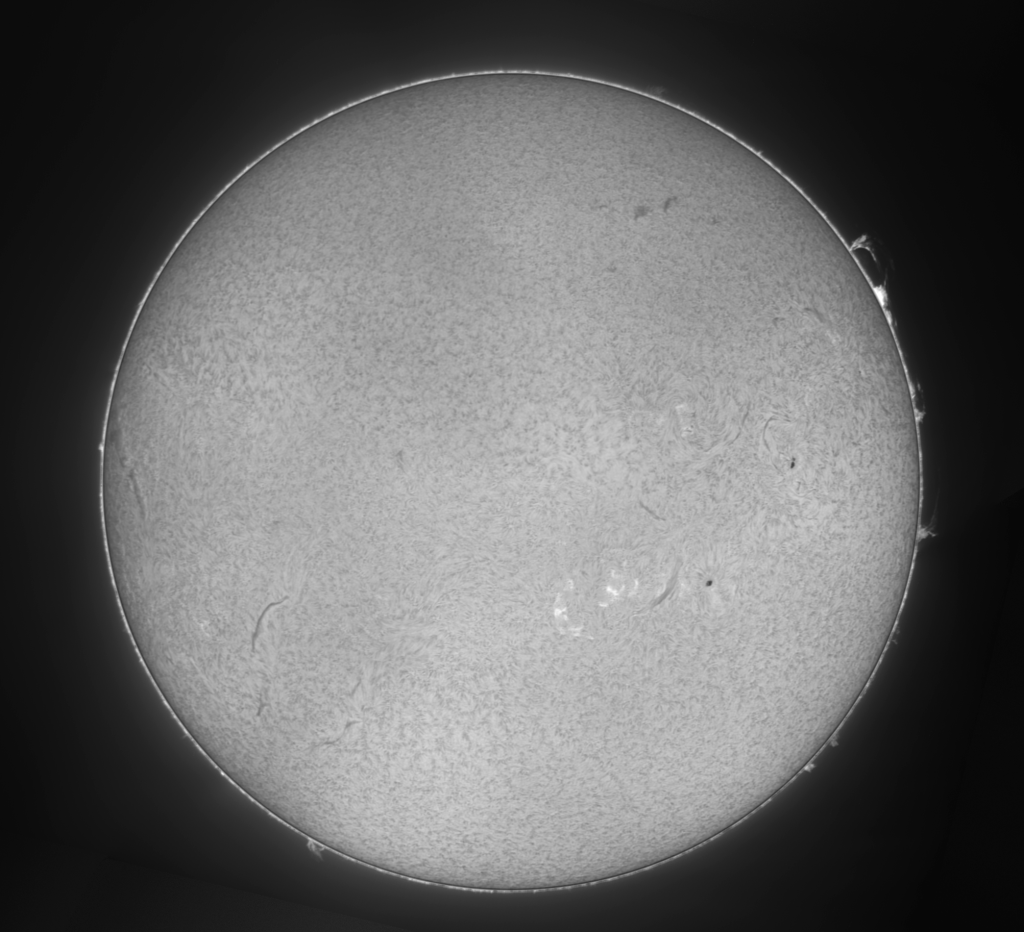
Another example: September 13, 2026 mosaic
Captured on September 13, 2026 at 20:29 UTC, same rig and pipeline.
Sun Observation – 2026-05-24
Posted by jmeriaux in Astrophotography, Sun on May 25, 2026
Taken at 20:05 UTC on 24th of May 2026.
Captured in H-Alpha using my William Optics 60mm refractor with a Daystar Quark filter and a ZWO ASI 432MM camera. The final image is a mosaic of 4 panels, each stacked from about 500 frames.

Sun 1st of September 2024
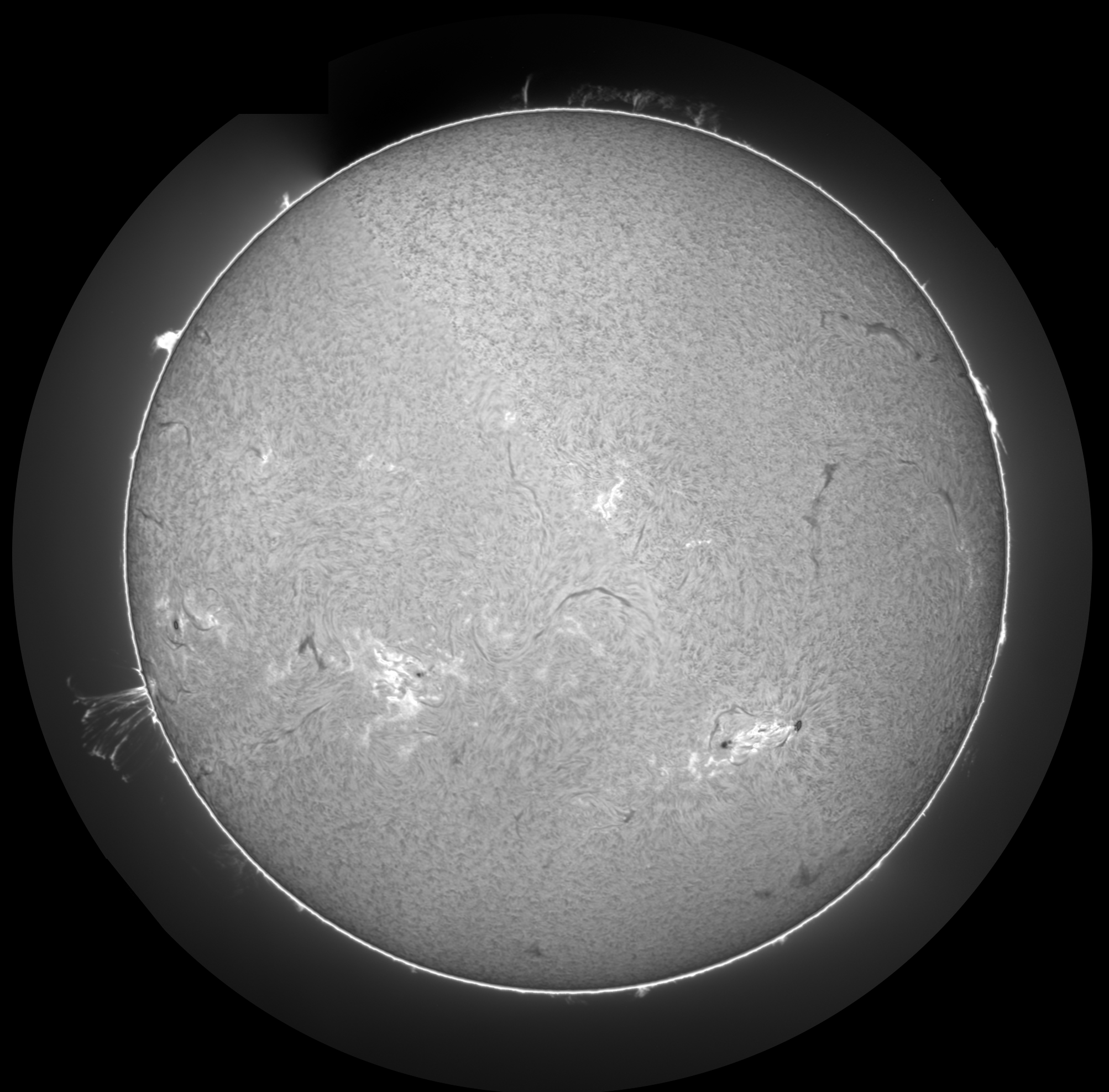
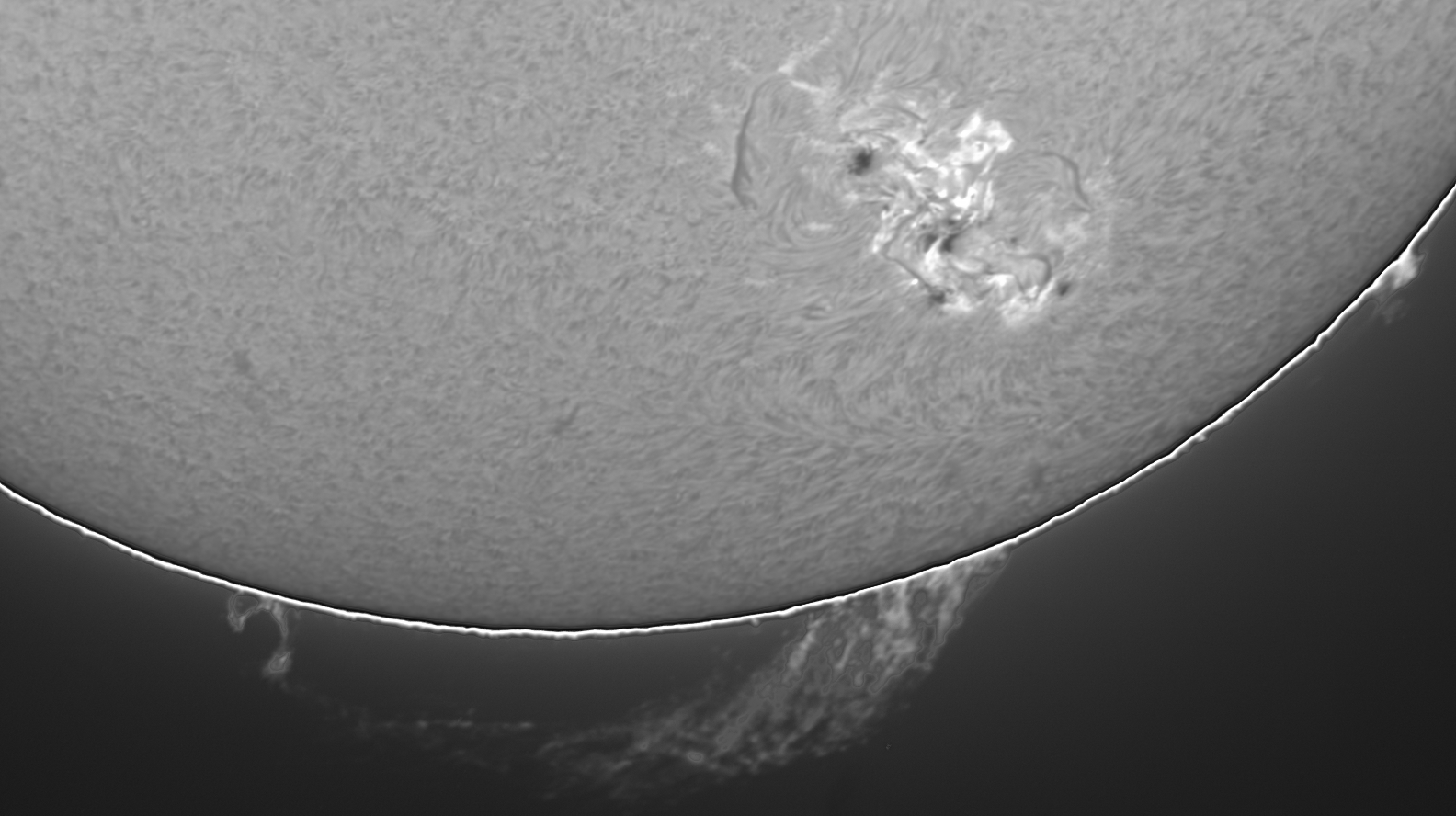
Another day of strong solar activity. This is captured in H-Alpha using my William Optics 60mm Refractor, with a Daystar Quark Filter. This is a mosaic of 4 images made from 300 frames each. The Camera used was a ZWO ASI 432MM. Image was captured the 1st of September 2024 at 19h43 UTC from Concord, CA.
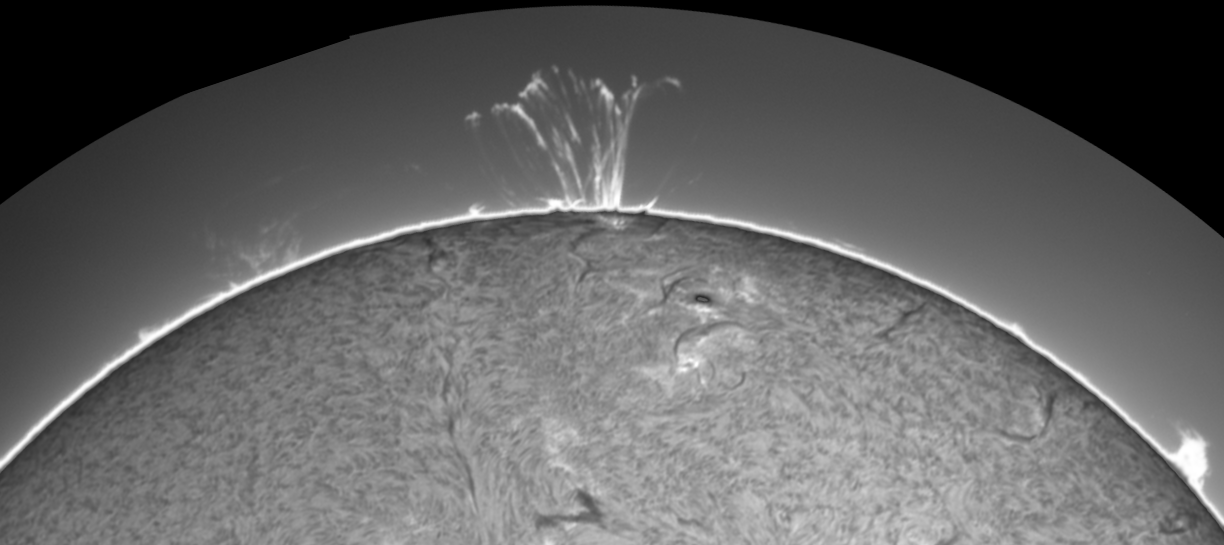
Below is a zoom on the large protuberance from the image taken with the William Optics 60mm refractor.
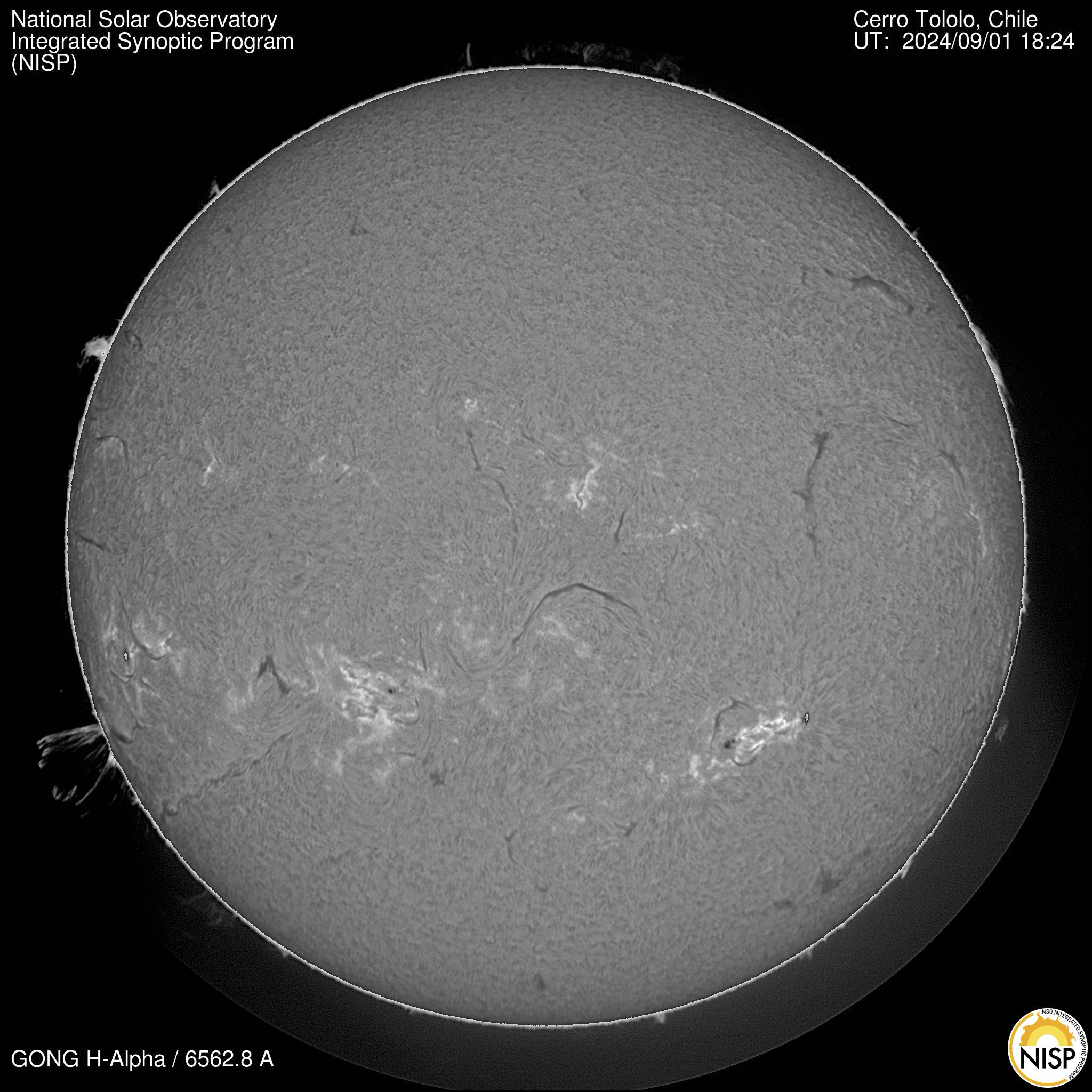
As a comparison, here is a picture of the Sun taken earlier the same day by the National Solar Observatory Integrated Synoptic Program (NISP).
Sun on 5.11.2024 – Cont’d
Posted by jmeriaux in Home, Sun, Uncategorized on May 27, 2024
I managed to capture the Sun this days in Visible Light, Calcium-K Wavelength, and H-Alpha wavelength.
This is the Sun captured in H-Alpha using my William Optics 60mm Refractor, with the Daystar Quark Filter. This is a mosaic of 4 images made from 700 frames each. The Sunspot group (Region 3664 – CR 2884) on the bottom right is very active and emitted large flares. This was taken on 5/11/2024 at 20h16 UTC from Concord, CA.

The same image at the same time, with a Stellarvue SVX 100mm, a Herschel Wedge and a Calcium K filter (Baader Calcium-K 8nm). I am using the same camera as above. The Faculae are more visible on the Sun’s surface. Don’t look at the Sun using such filter as the UV will harm your eyes. This was taken on 5/11/2024 at 19h57 UTC from Concord, CA.
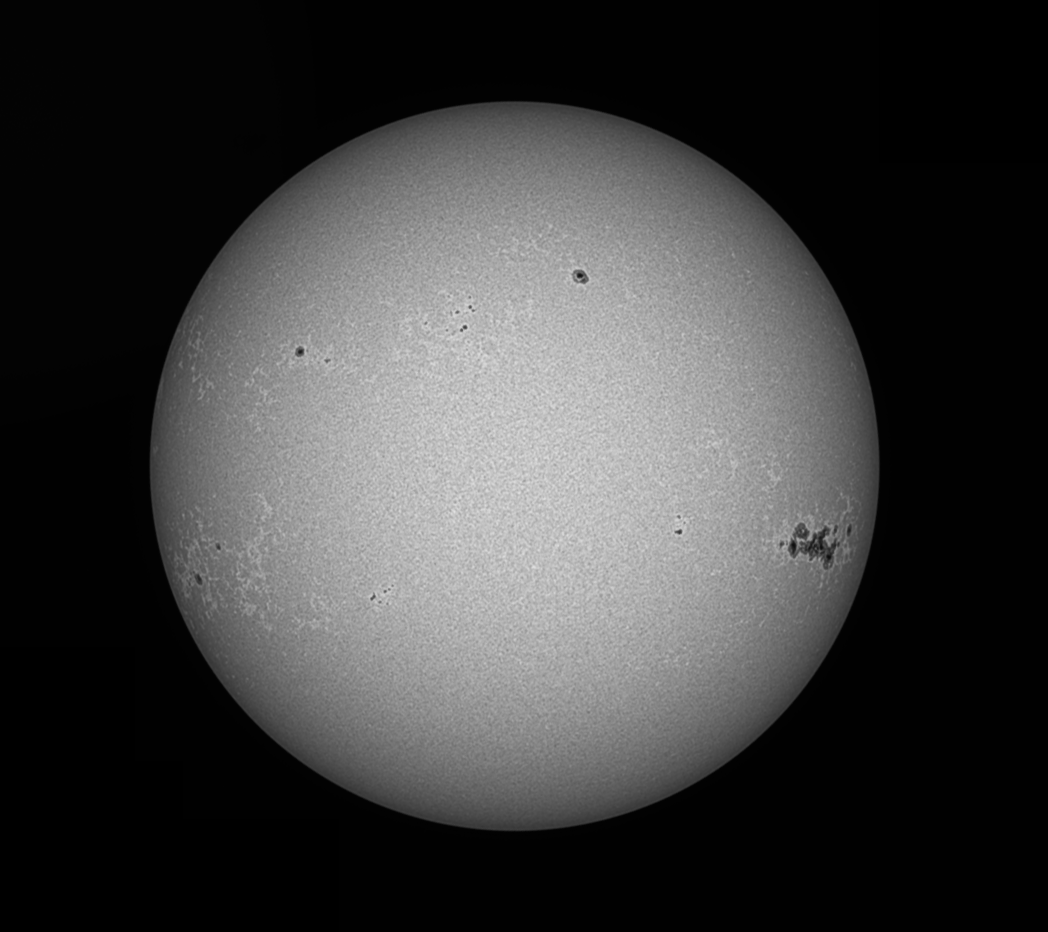
Last, this is the Sun in Visible light . This was taken on 5/11/2024 at 19h26 UTC from Concord, CA. This was taken on 5/11/2024 at 19h43 UTC from Concord, CA.

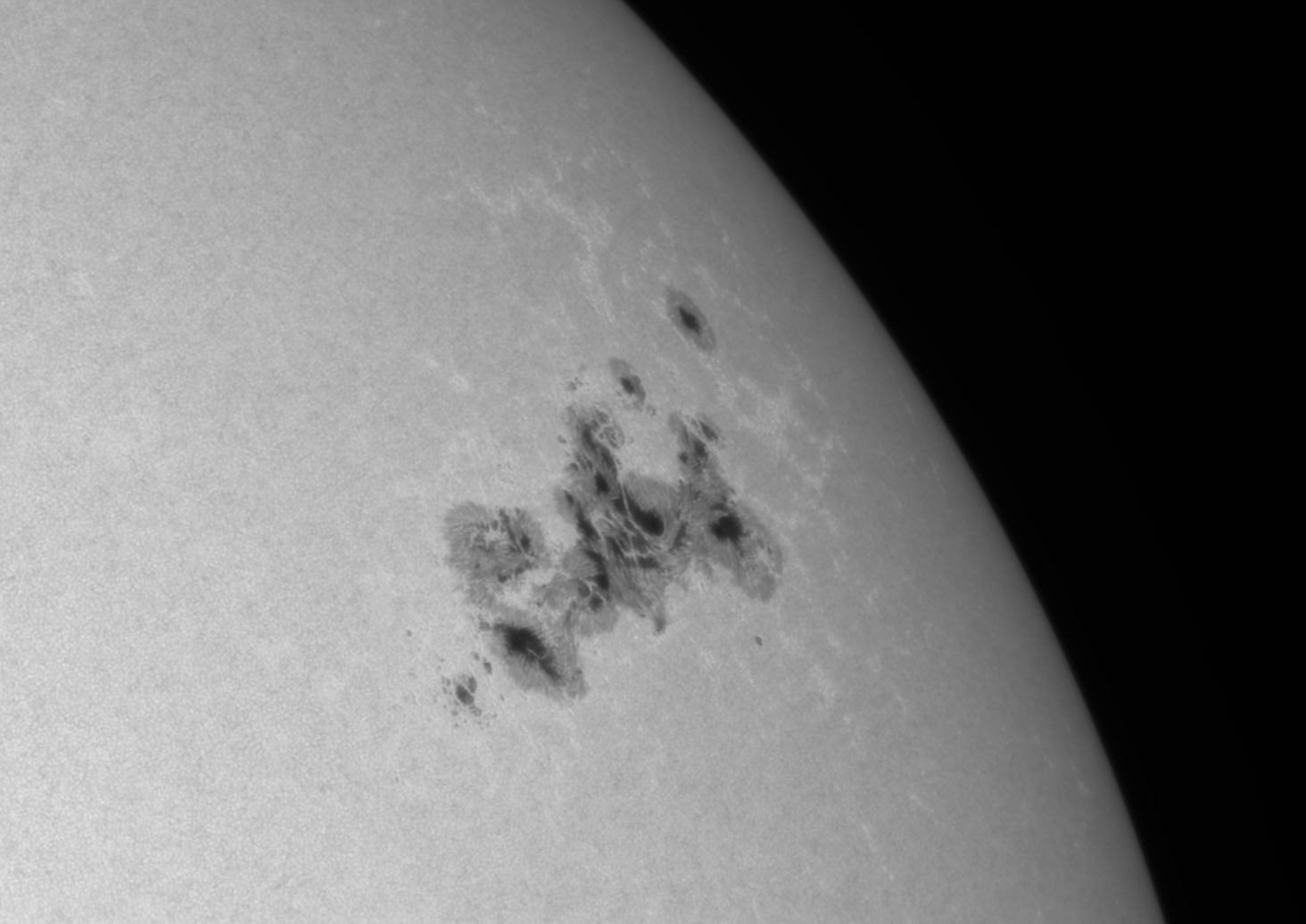
With the Sun activity almost at its maximum, the Solar spots are spectacular. The Sunspot group below (Region 3664 – CR 2884) is the same group on the bottom right in While Light.
The Instrument was a Stellarvue SVX 100mm with a 2x Barlow. The Camera is an ZWO camera ASI 290MM. This camera is quite sensitive, with Small pixel for high resolution planetary pictures.
Sun on 5.10.2024 with Daystar Filter
The sun was very active this may, with Aurora Borealis seen at very low latitude.
This picture is taken with a 60mm William Optics Telescope with a Chromosphere Daystar Quark Filter. The Chromosphere filter has a dial where the HAlpha wavelength can be tweaker. The visual views are impressive, but a small telescope at F/6 works best because the Daystart Filter has a 4x Barlow integrated, and is optimized for roughly a resulting focal ration of 25.
Visually, the best with this filter and this small Apo is a 25mm eyepiece, to view the entire solar disc.
This is a mosaic of 4 images made from 700 frames each. The Camera used was a ZWO ASI 432MM. Even with a relatively larger frame (17mm), combining multiple images for a complete view of the Sun is needed. This was taken on 5/10/2024 at 19h08 UTC from Concord, CA.
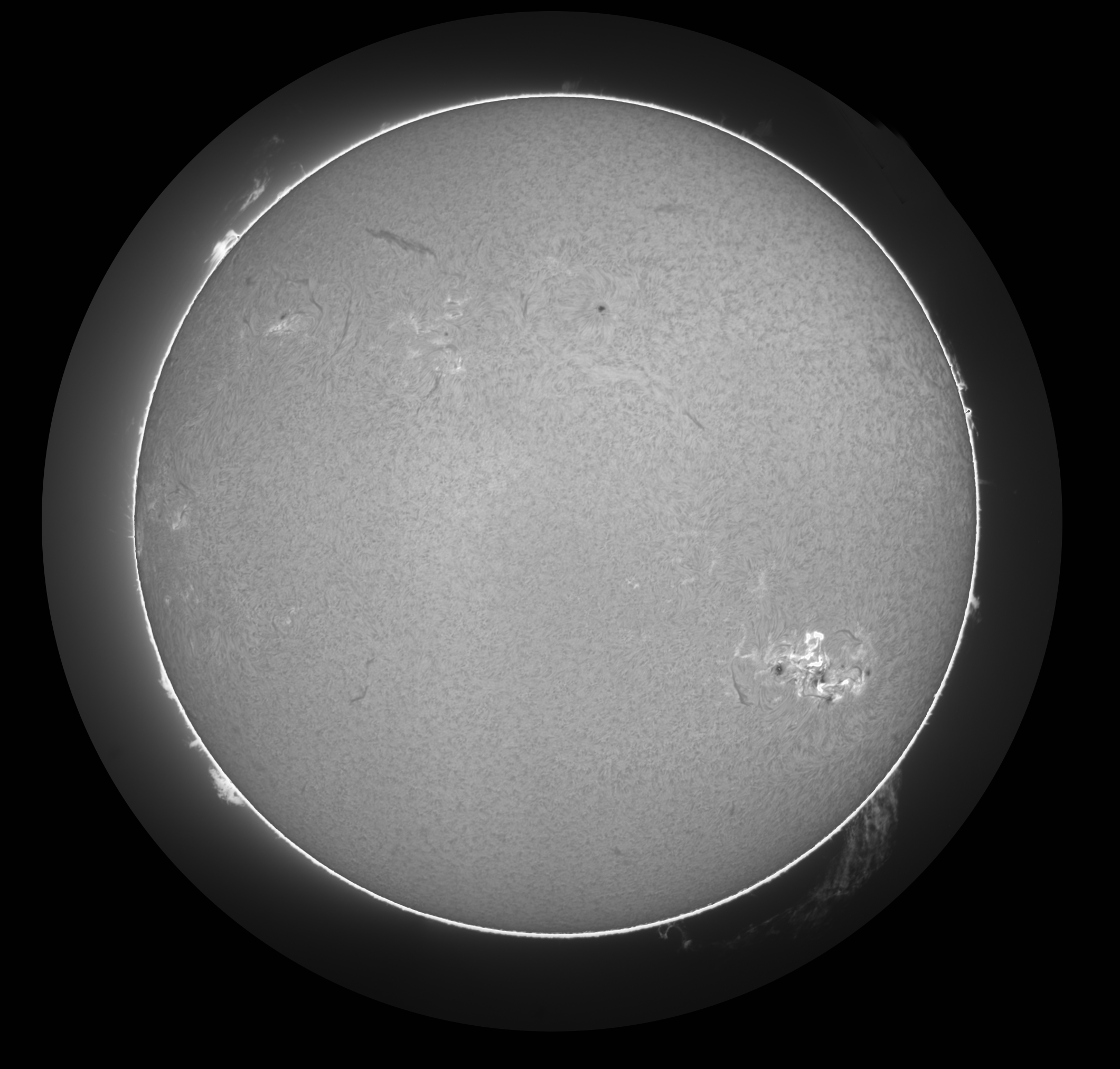
The large solar spot group on the bottom right is the region 3664 (Carrington Rotation 2284).
The details on region 3664 below was captured using the same settings, with a ZWO ASI 290 MM camera which has a much smaller pixel size (but also a much smaller sensor). This was taken on 5/10/2024 at 19h021 UTC from Concord, CA.
5th of June 2012 Venus Transit
Posted by jmeriaux in Astrophotography, Planets, Sun, Uncategorized on September 3, 2018
The next Venus transit will be in December 2117… I took these pictures with my Coronado 90mm H-Alpha telescope in June 2012. You can get more information on this historical Venus 2012 transit on the Nasa web site.
Below is a picture of the first contact on the 5th of June 2012, at 3:07 PM PDT at San Bruno CA. The disk of Venus can be guessed in the mid-section.

A non-processed movie of the entry of Venus can be see below. It shows the first minute of the entry of the disc in front of the Sun.
The next picture was taken at 3:22 PM PDT. The Venus’ disk is clearly visible at this time. There is a large solar filament on the top of the image.

Later at 5:59PM PDT Venus is making its progression on the Solar disc. Solar spots can be seen on the left side of the Venus’ disc.

Solar Spots with SV 90 Raptor and Baader Solar Film
Posted by jmeriaux in Astrophotography, Sun on December 24, 2010
Date: 9/26/2010
Location: San Bruno, California
These pictures were taken with the Baader Solar Film and my DMK black and white camera.
Sun granules and faculae are featured in respectively the first and second pictures
The Stellarvue SV90 (3.5″) is a fine instrument for Sun white light Astrophotography.
It reaches temperature equilibrium quite fast – and with its great optical quality it can get as far as a 3.5″ aperture can possibly go…
In addition I used a Televue x5 Powermate. Since the SV90 has a relatively short focal ratio (f/d 7) the x5 powermate is necessary to get high resolution pictures.


Processing:
– Avistack
– Photoshop CS4
– Astraimage Wavelet filter

