Posts Tagged iOptron
Moon Mosaic Application with Claude Code
Posted by jmeriaux in Astrophotography, Moon on September 19, 2026
A lunar mosaic needs the same finishing work as a solar one — joining overlapping frames, then deconvolution, sharpening, and dealing with the high dynamic range between the sunlit surface and the terminator. I used to do all of that by hand in Photoshop.
I built MoonMosaic with Claude Code — similarly to SunMosaic. It joins 2 to 6 overlapping frames into one mosaic, or takes a single shot as it is, then offers the finishing steps a lunar image usually needs: deconvolution, sharpening, flip, rotation, and a terminator layer that tames the Moon’s dynamic range.
In my workflow, each frame going into a mosaic is pre-processed the same way as for the Sun: a 16-bit video of the region, stacked in AutoStakkert!4 with 500 final frames, using the Laplace quality estimator and a grid of alignment points over the surface — saved as a 16-bit TIFF. Those TIFFs are what MoonMosaic takes in.
Layers and a mask are created behind the scenes, so that the terminator features can be processed in a separate layer. The final output (a TIFF file) can be opened in Affinity Photo, or any other tool supporting the TIFF format and TIFF layers, for additional processing.
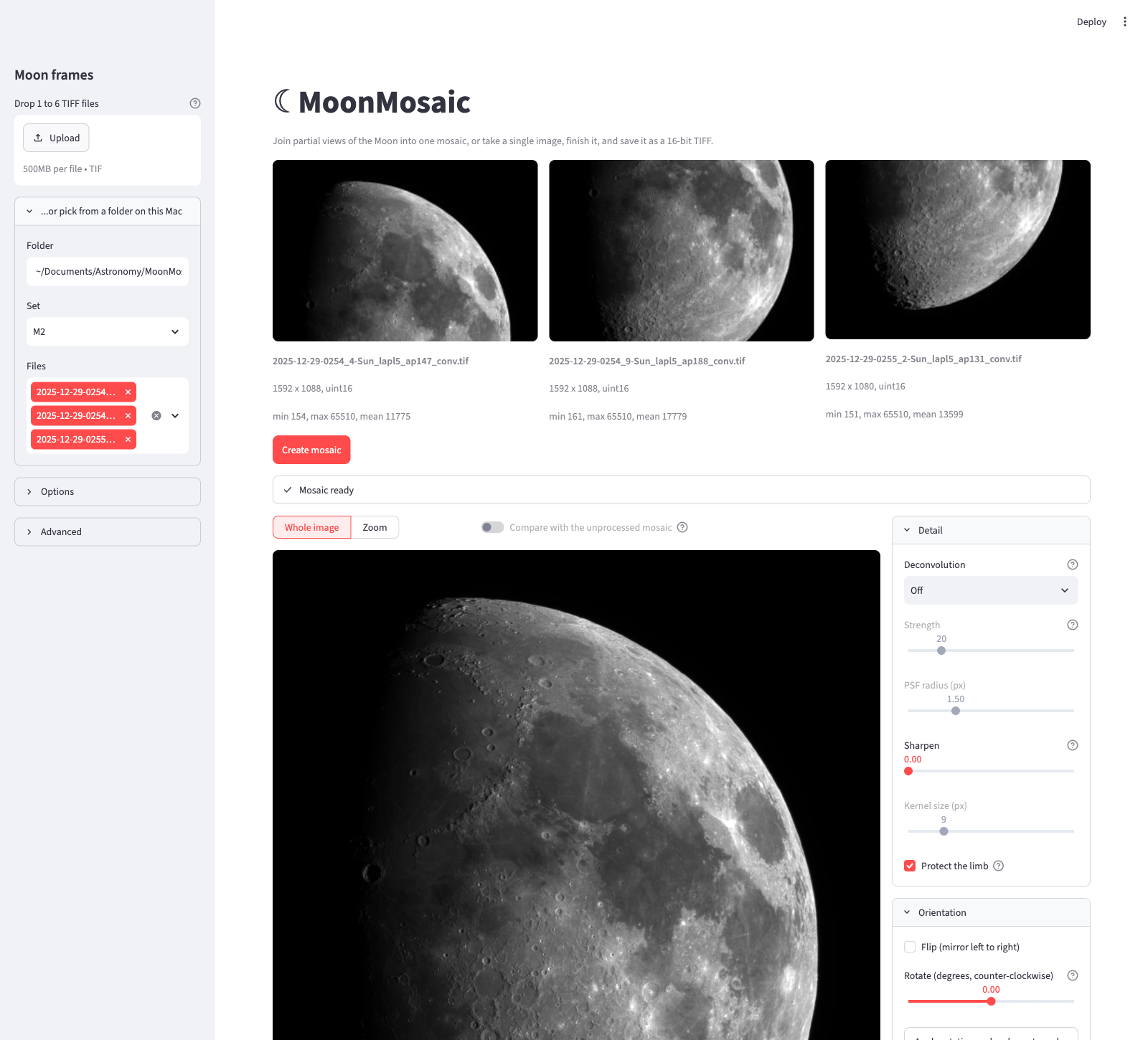
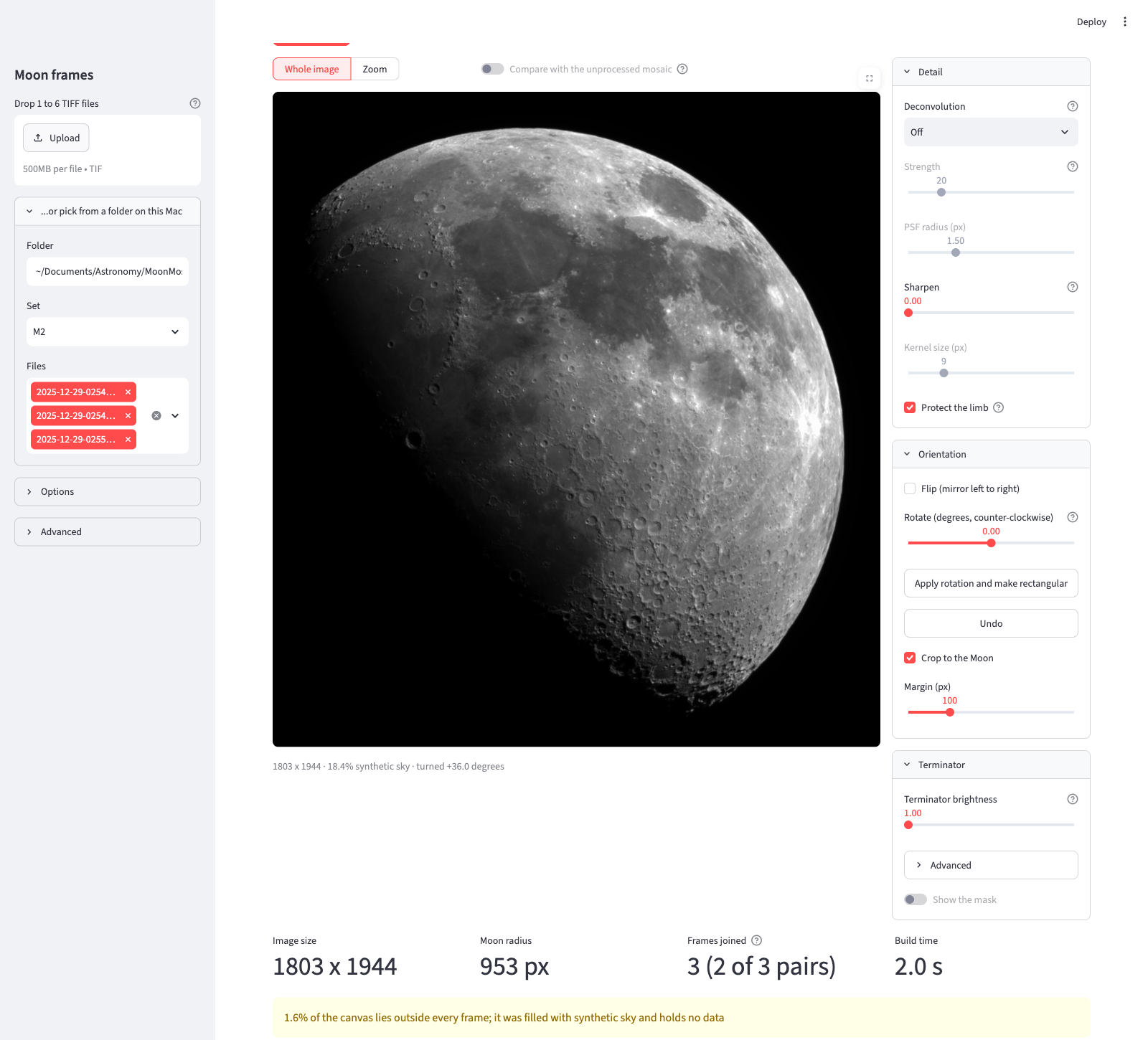
It’s open source and posted on github.com/m42cococa/MoonMosaic. A ready-to-run .dmg installer is available here — Apple Silicon Macs only. It also runs as a local browser app or from the command line.
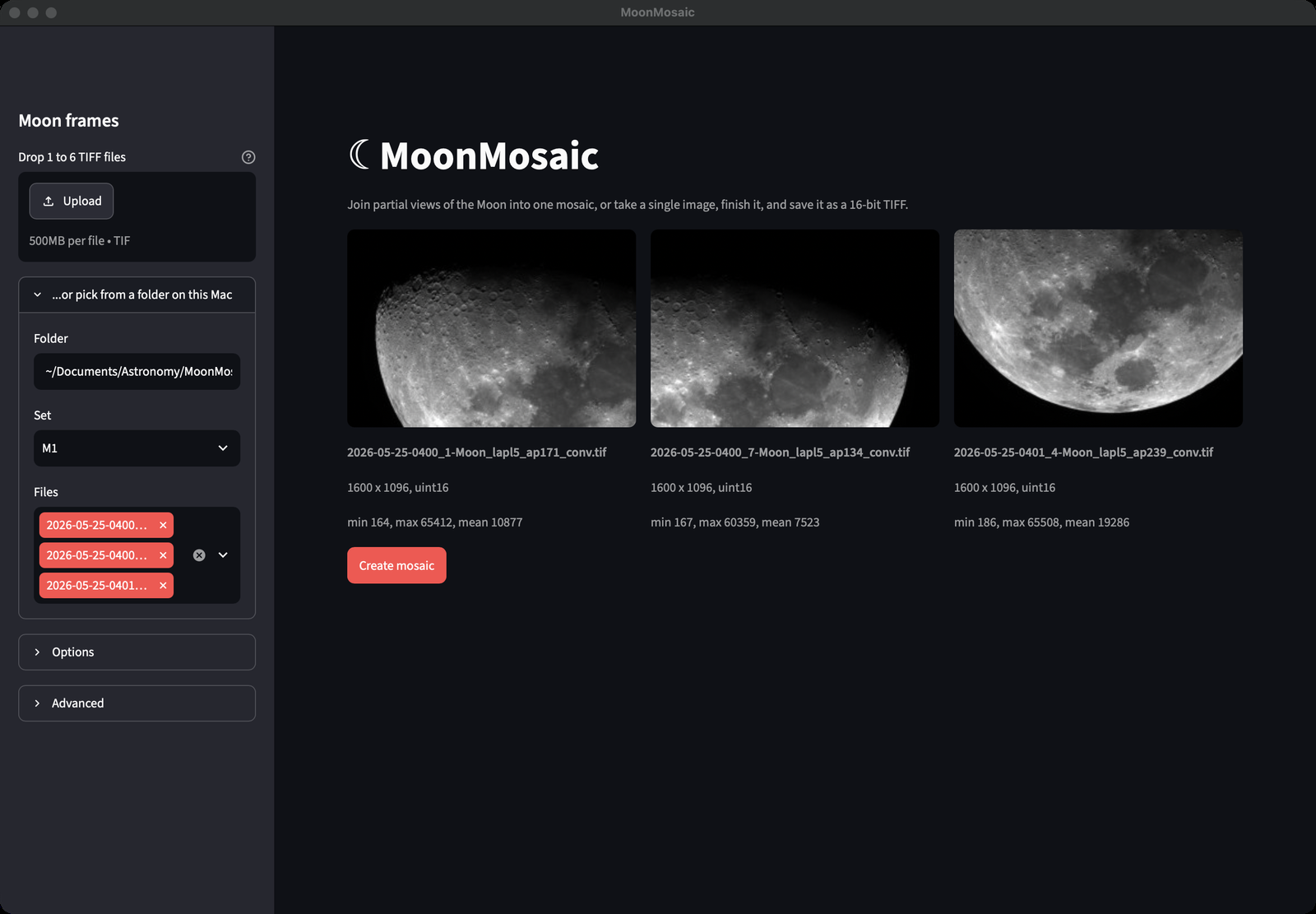
The Apennines Mountains
Posted by jmeriaux in Astrophotography, Moon on May 25, 2026
Taken using my 150mm Rumak-Maksutov and the same ZWO ASI 432MM camera I used for the previous Sun picture.
I added a 2x Televue Barlow in the imaging train.
Taken on 2026 May 25th at 4:12 UTC.
It was processed in Photoshop from two pictures, each stacked from about 500 frames.

About the Image
This view looks across the eastern shore of Mare Imbrium. The Montes Apenninus — the lunar Apennines — form the rugged range sweeping across the lower half of the frame, marking the southeastern border of the mare. A few landmarks worth picking out:
- Archimedes — the large, smooth-floored crater near the centre, at the northwestern foot of the Apennines.
- Aristillus and Autolycus — the pair just above and to the right of Archimedes, with Aristillus showing bright ejecta and central peaks.
- Cassini — above and right of centre, recognisable by the smaller crater sitting on its flooded floor.
- Plato — the dark-floored crater at upper left, on the northern shore beside the terminator.
- Vallis Alpes (the Alpine Valley) — the straight cleft slicing through the Montes Alpes near the top.
- Aristoteles and Eudoxus — the prominent crater pair along the right edge.
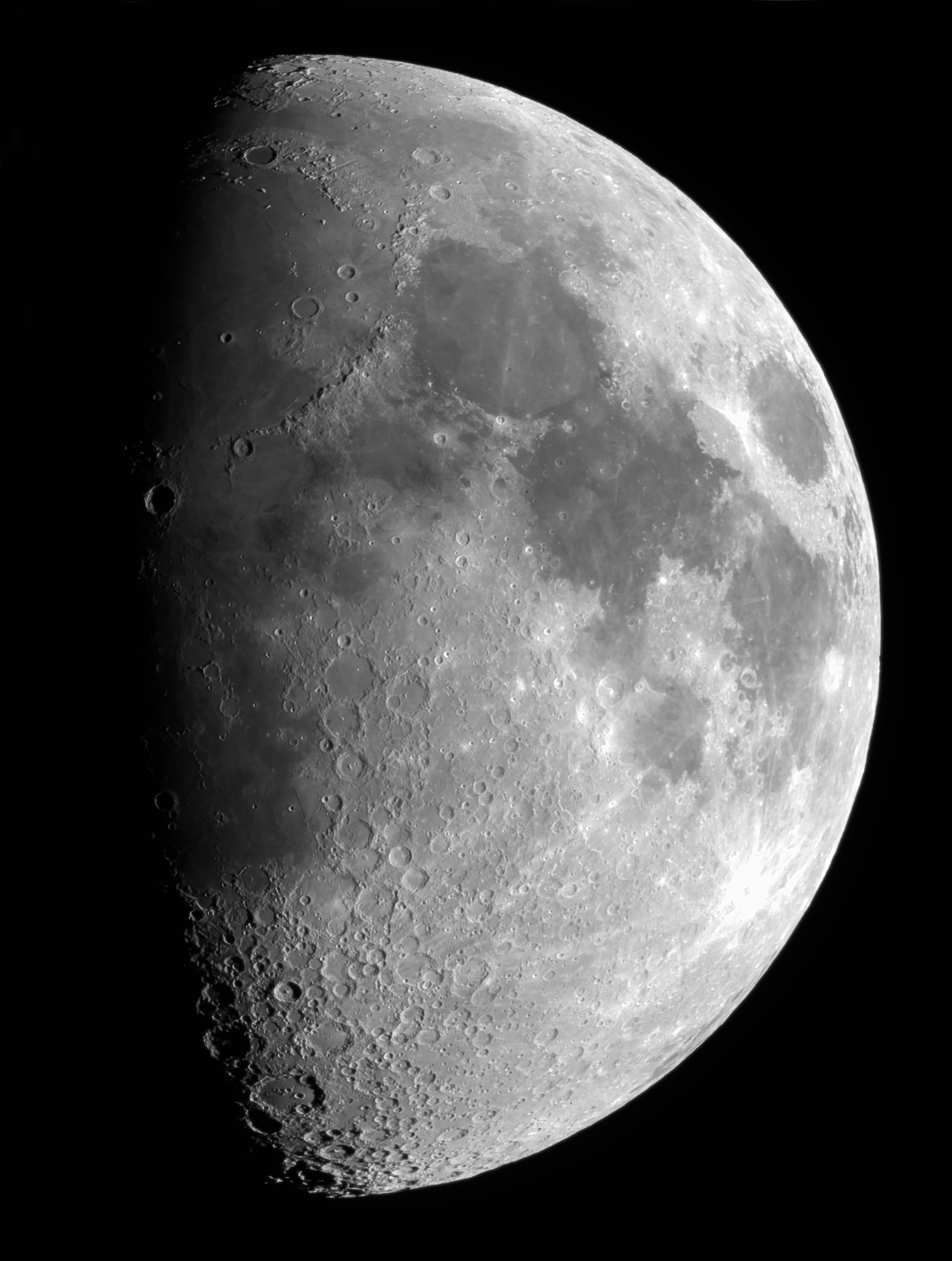
Moon First Quarter – December 2025
On the night of December 29, 2025, I captured the Moon at first quarter from Concord, California. Conditions were favorable for lunar imaging, and the result is this composite assembled from three separate pictures.
Equipment & Capture Details
The image was taken using an iOptron 150mm Rumak-Maksutov telescope paired with a ZWO ASI 432MM monochrome camera. Each of the three panels was captured with 500 frames, which were then stacked and sharpened using AutoStakkert. The final composite was assembled at 02h51 UTC.