Jellyfish, Cone and Rosette Nebulae in H-Alpha with SVR90T
Posted by jmeriaux in Astrophotography, Deep sky objects on February 10, 2011
Location: San Bruno, CA
Telescope: Stellarvue SVR 90T with Televue x0.8 reducer on Takahashi NJP-Z Mount
Camera: Qhy9 CCD with Astronomik H-Alpha 12nm Filter
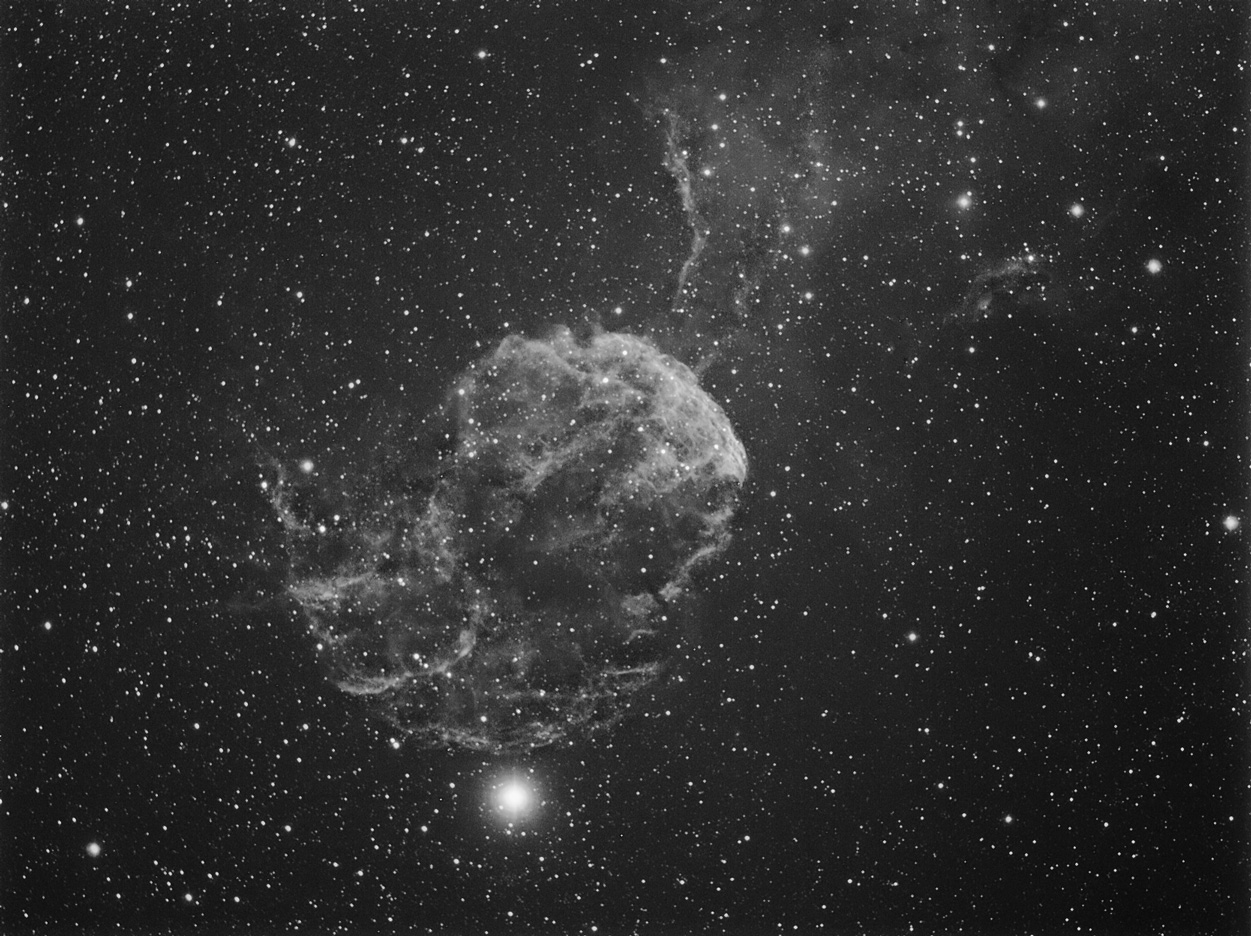
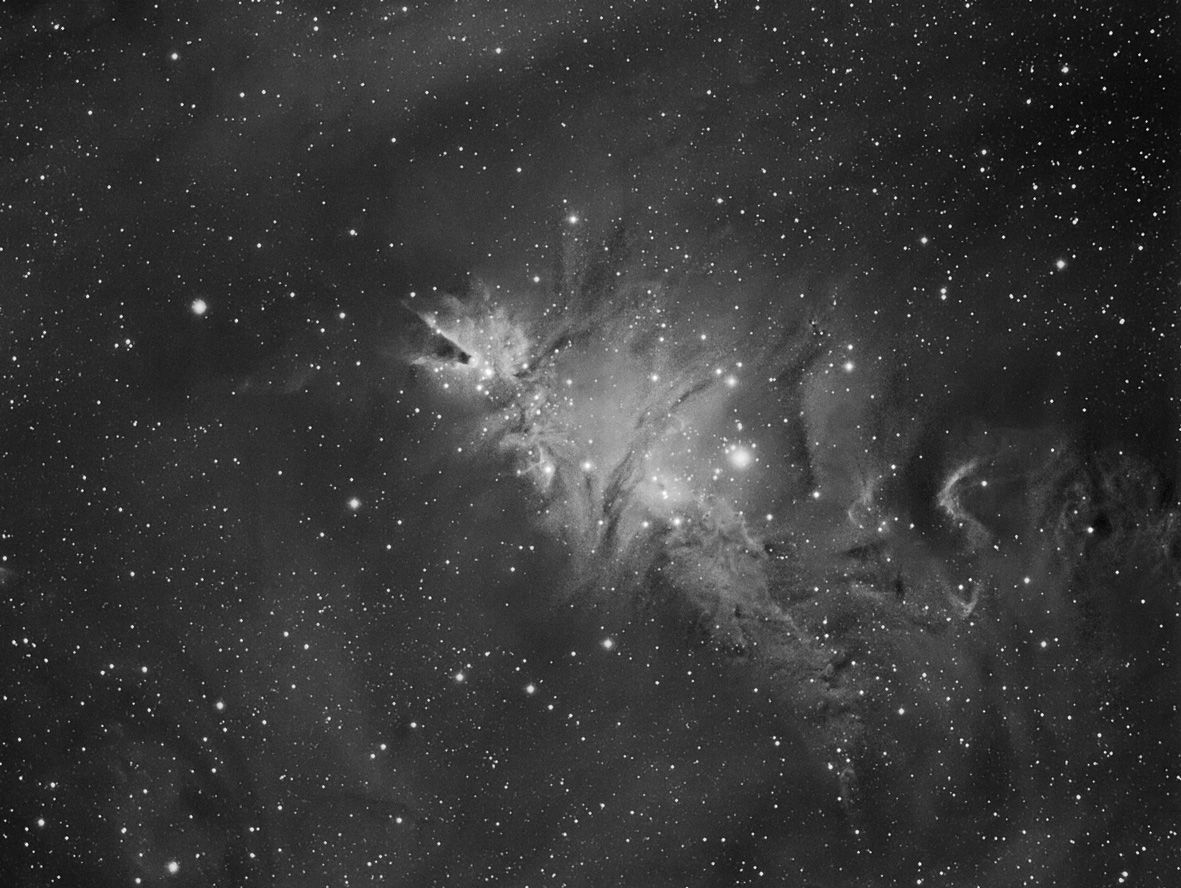
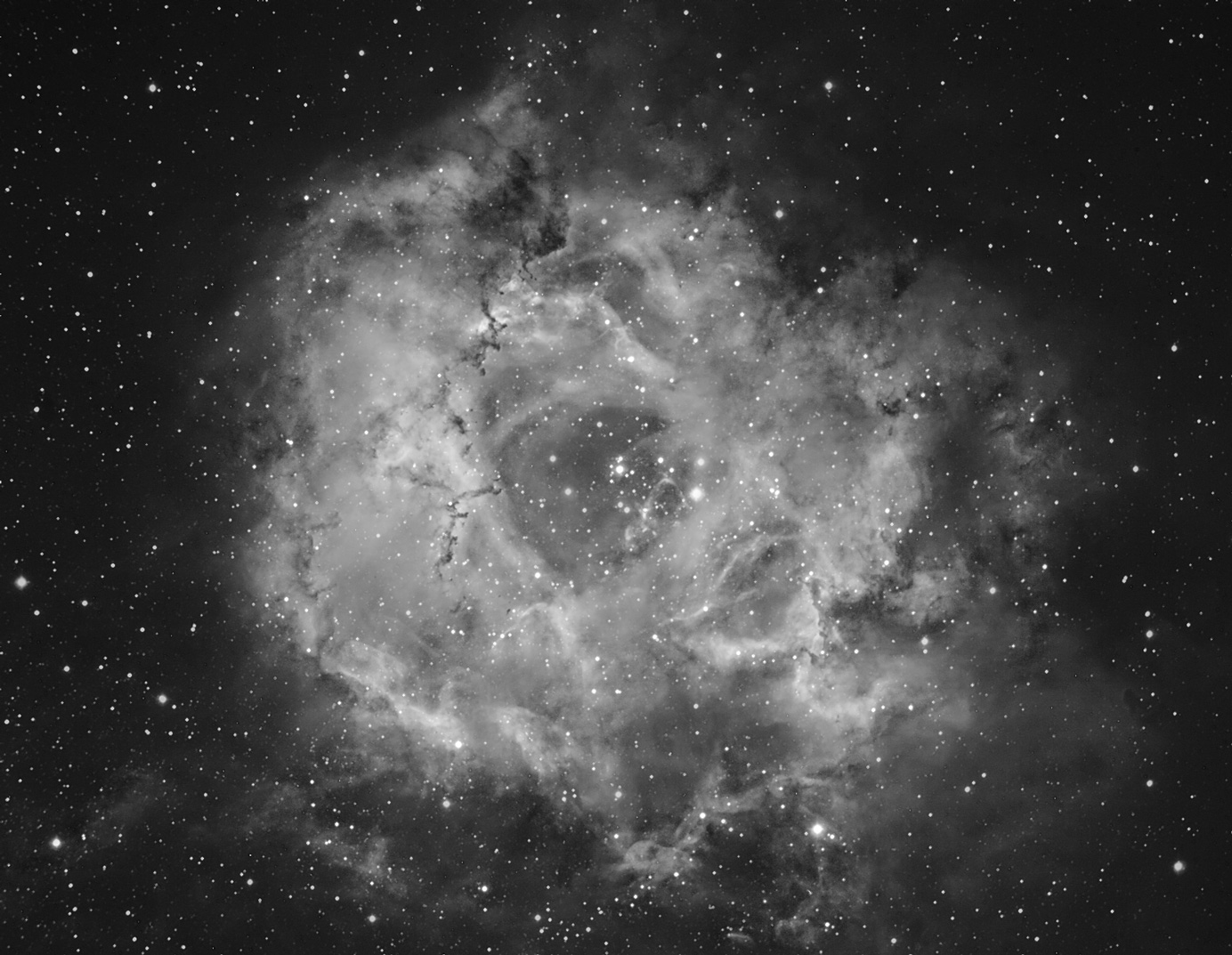
Even with the short focal ratio (f/d 5.6) obtained with the televue reducer, I had to apply 2×2 Binning and take a fair amount of exposure to get details in the Nebulae.
The H-Alpha filter does wonder to combat light pollution, even though the FWHM of this filter is not very narrow (12 nanometers).
Some words about the combination of Stellarvue SV 90T and televue reducer. I had to find the best distance between the CCD chip and the reducer / flattener. Initial trials with a distance of 58mm were not successful. Then 55mm of distance between the CCD chip and reducer/flattener seemed to yield better results.
My tests were done with the Qhy9 having a relatively small sensor (15mm x 19.7mm) – and even with this sensor size stars were not perfectly round on the egdge.
That’s why I am not sure if the televue 0.8x reducer/flattener is a good match with the Stellarvue SV90T for large chips. But at least in my case it turned out fine. On the other hand, the Stellarvue flattener gives perfect flat images with round star till the edge with an APS-C size sensor … but … the F/D is still at 7, making it more difficult to image faint extended objects. That is why I opted for the Televue reducer for this set of images, even though it does not produce a perfect flat field with this telescope optics.
Jellyfish Nebula (IC 443 or Sharpless 2-254) – 01/28/2011
Cone Nebula / Christmas Tree Cluster (Sharpless 2-273, Ngc 2264) – 01/28/2011
Rosette Nebula (Caldwell 49, Sharpless 2-275) – 01/22/2011
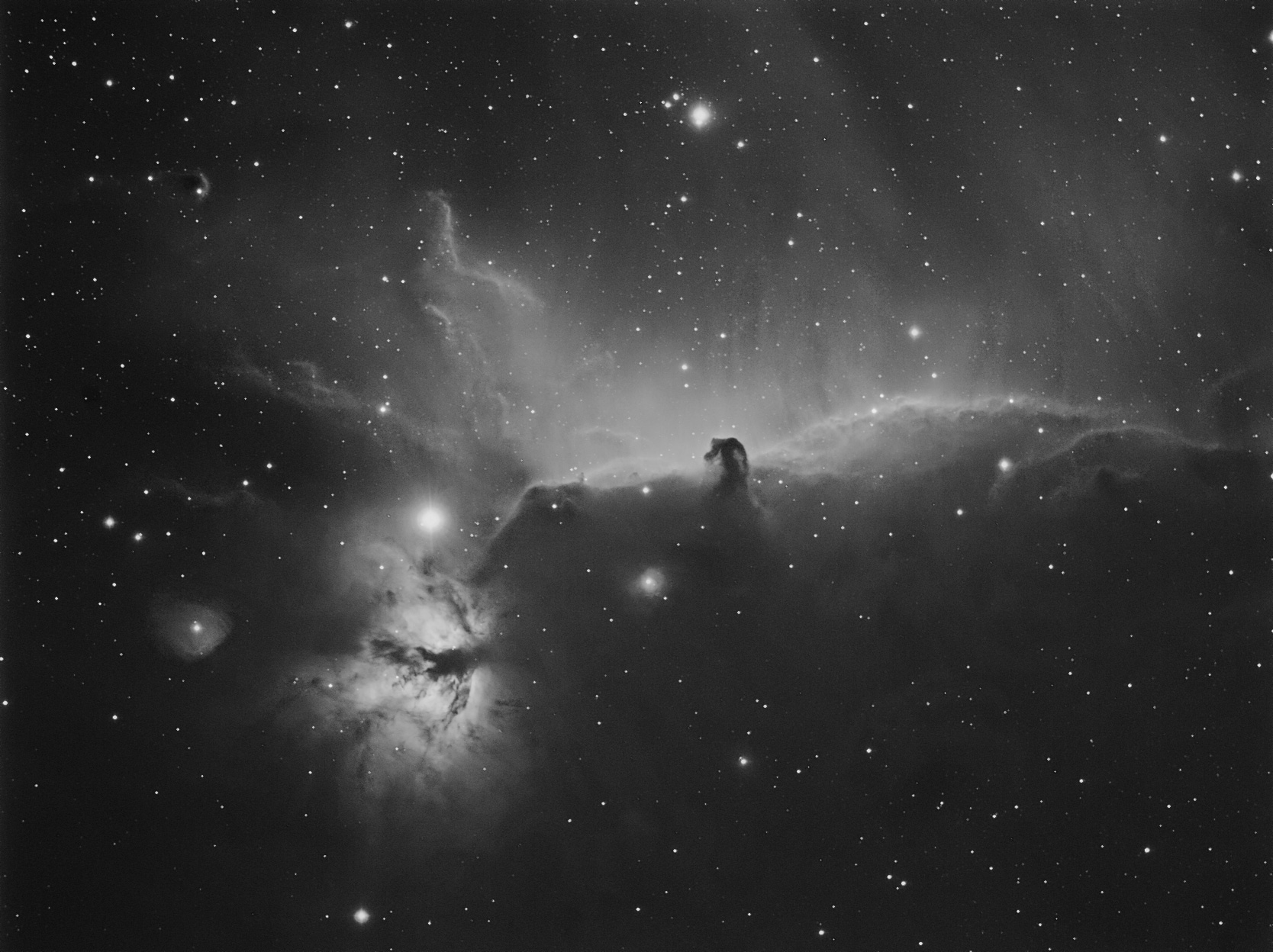
Horse head and Flame Nebulae with SVR90T and H-Alpha Filter
Posted by jmeriaux in Uncategorized on January 30, 2011
Date: 01.23.2011 (last quarter moon)
Location: San Bruno, CA
Telescope: Stellarvue SVR 90T with Televue x0.8 reducer on Takahashi NJP-Z Mount
Camera: Qhy9 CCD with Astronomik HAlpha 12nm Filter
This is a stacking of 11 exposures of 8minutes. Even with the short focal ration (f/d 5.6) obtained with the televue reducer, I had to apply 2×2 Binning and take a fair amount of exposure to get details in the Nebula.
The H-Alpha filter does wonder to combat light pollution, even though the FWHM of this filter is not very narrow (12 nanometers).
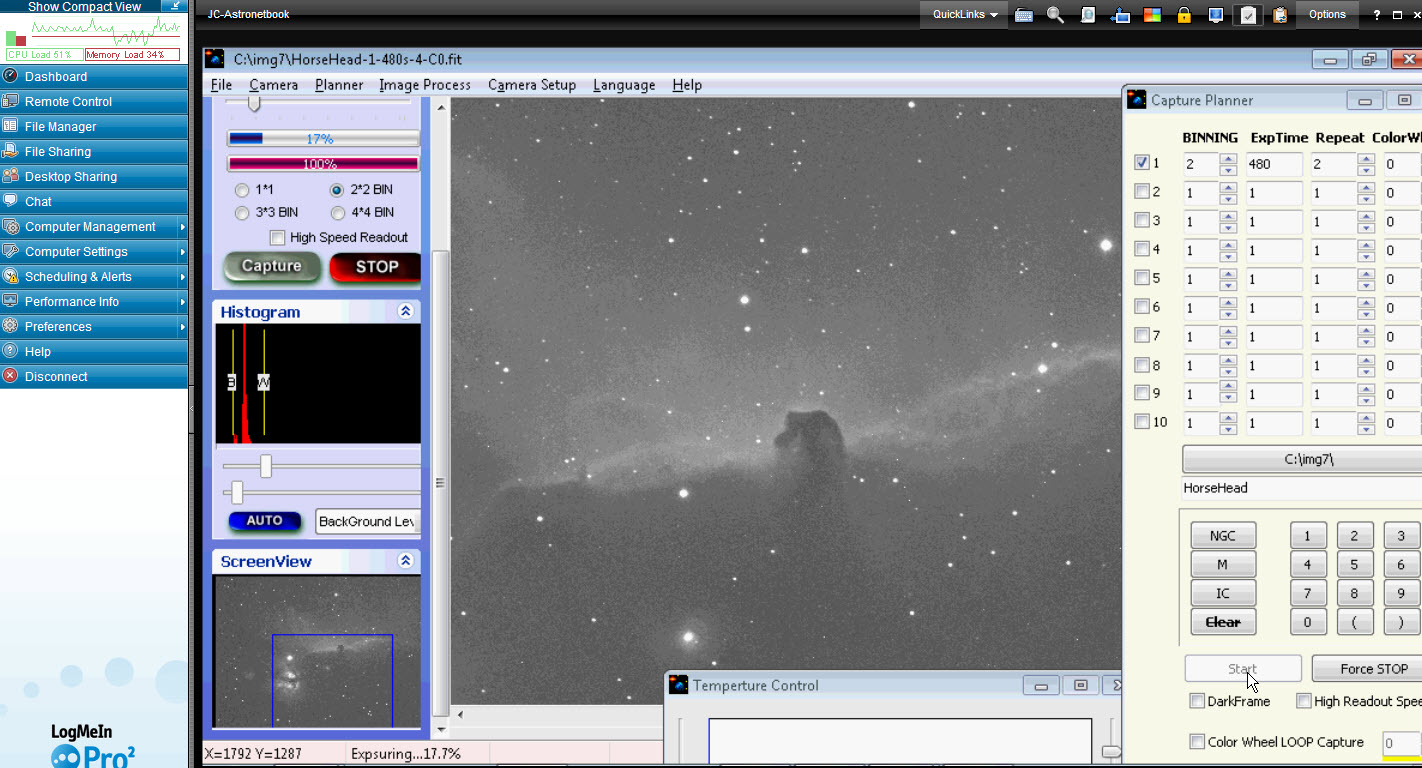
To capture this picture, I used the software Logme in to monitor the imaging session from the comfort of my living room…
Configuration:
- Imaging setting outside, connected to my Toshiba Netbook, accessing the Network from a Wireless connexion. The Netbook controls the Qhy9 camera, the Orion autoguider, and the Takahashi NJP-Z mount (Ascom driver).
- My Laptop, in the living room, allowing remote access to the Netbook using the LogmeIn software.
With long imaging session, getting remote access allows me to check if nothing goes wrong [ issue with tracking, clouds, etc] – without having to check every 20 minutes outside!
Here is a screenshot of the log me in screen with remote access to the Netbook controlling the imaging set up:
Crab Nebula with C9.25 – Jan 2011
Posted by jmeriaux in Uncategorized on January 30, 2011
Location: San Bruno, CA
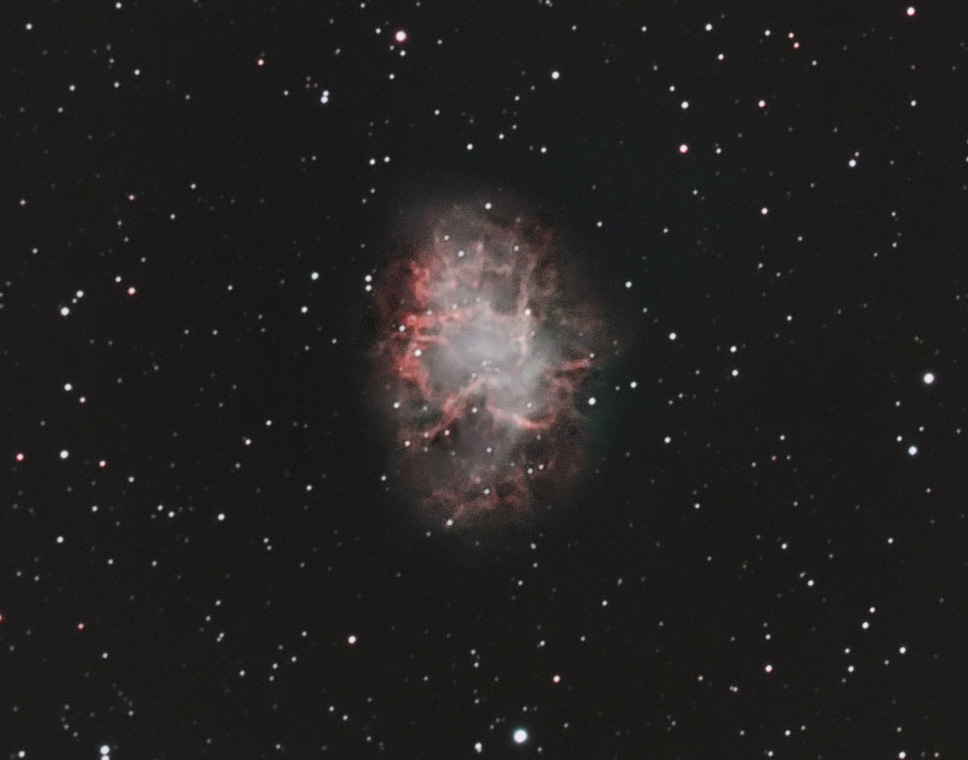
Telescope: Celestron 9.25 with F/d 6.3 reducer on Takahashi NJP-Z Mount
Camera: Qhy8 CCD with Astronomik CLS CCD Filter

This is the result of 16 exposures of 330 sec. The Celestron C9.25 is really a good choice for planetary nebula given its relatively long focal length, and its large aperture.
I find also that many planetary nebula are a nice target when on a light polluted site, since they have a relatively high surface brightness.
What is more important here is to have a night with good seeing conditions, very good tracking, take multiple shots, and stack!
Software: Maxim DL5, Photoshop CS4, Nik Sharpener
This is a crop of the previous image, showing more details in the Nebula dendrils.
Clavius with Mak Cassegrain 180mm
Date: 1/15/2011
Location: Sam Bruno, CA
Instrument: Orion Mak Cassegrain with Imaging Source DMK camera at f/d 15
Infrared Filter Astronomik IR Pro 742
Processing: Avistack for Image stacking, Astraimage Wavelet processing, Photoshop CS4
Seeing: 3-4/10
The use of the Infrared pass filter (pass wavelength above 742nm) allowed to pass through the turbulence. Not only the image was much more stable but showed also improved contrast (compared to a regular Infrared Cut filter).
Even if the IR pass filter reduces luminosity, the moon is such a bright object that each frame integration time is still small (1/10 second by frame for this picture – about 1,000 stacked frames ).

Eskimo Nebula (NGC 2392) with C9.25
Posted by jmeriaux in Astrophotography, Deep sky objects on January 8, 2011
Date: 1/5/2011
Location: San Bruno, CA
Telescope: C9.25 on NJP-Z mount
Camera: Qhy8 with CLS CCD Filter
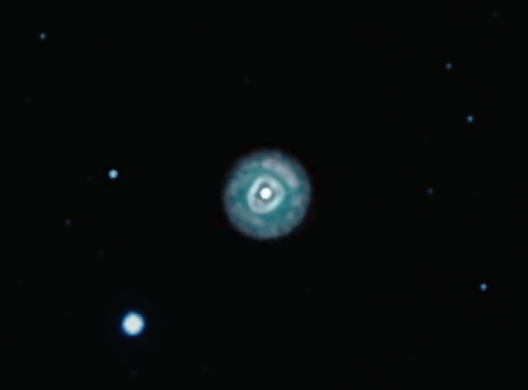
16 exposures of 2 minutes at f/d 6.3.
Processing: Maxim DL5, Photoshop CS4, Astraimage Wavelet filter
The Eskimo planetary nebula has a fairly small angular size: about 48″, comparable with the apparent size of Jupiter.
At focal plane, the scale was about 1.15″ by pixel when taking this image.
Collimation is critical at this focal length – and I made sure the SCT was well collimated.
Given its high surface brightness, shooting NGC 2392 benefits from many short exposures to get the best of seeing conditions, and processing techniques such as sharpening or wavelet filtering.
For this pictures, I tried out my new Losmandy dovetail plate on which the guidescope (Takahashi fs60c) is attached.
I had trouble with tube flexture in the past with other systems to attach the guide scope to my c9.25, but with this great dovetail plate, the guide scope is now coupled to the C9.25 OTA in a very rigid way.
Helix Nebula with Astrotac – New Mexico
Posted by jmeriaux in Astrophotography, Deep sky objects, Wide Field and Telephoto on December 24, 2010
Date: 9/12/2010
The month of December is definitely not great for astronomy given the clouds / rain – so I am taking the occasion to process and post shots I took in September in New Mexico,
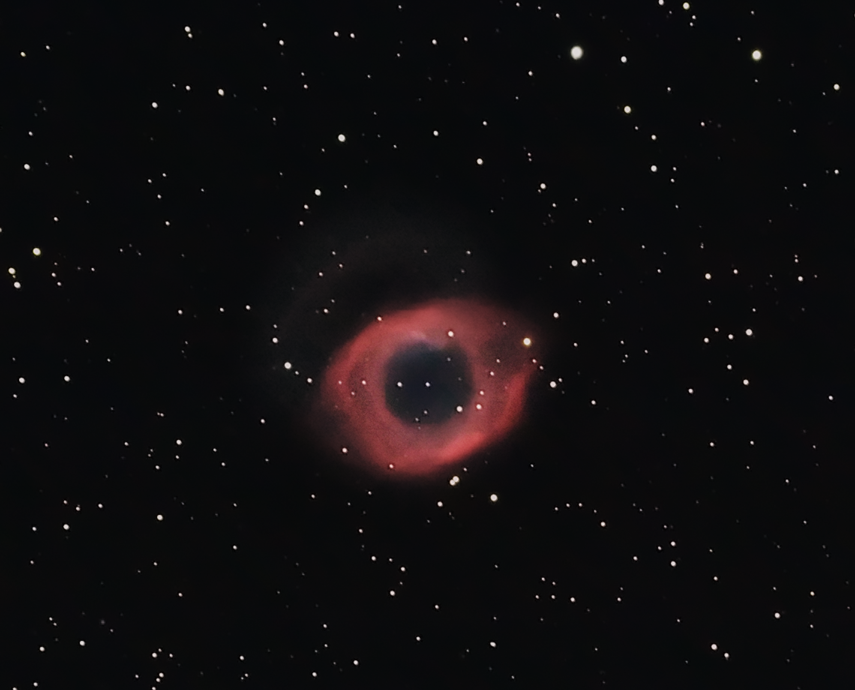
These two pictures from the Helix nebula were taken with respectively my Canon 200mm Teleobjective, and Takahashi FS-60C, both having very fine optics.
Both were done on my Astrotrac Travel system mount (unguided). Star were slightly elongated because of poor polar alignment, and I tried to fix it as much as possible using Photoshop and techniques described in the excellent book “The New Astro Zone System for Astro Imaging” by R.Wodaski and R.Croman.

Interesting to see the comparison there. Since shots were unguided I was limited to a short exposures especially with the FS-60C. The picture taken with the FS-60C is definitely more detailed – stars are “tight” but colors are not captured as nicely as with the Teleobjective open at f/d 3.5 because of the short sub-frame duration.
Even though more pictures were stacked with the FS60, still the short F/D ratio of the Canon Teleobjective makes the difference when capturing colors from green to yellow to red in this great planetary nebula.
Solar Spots with SV 90 Raptor and Baader Solar Film
Posted by jmeriaux in Astrophotography, Sun on December 24, 2010
Date: 9/26/2010
Location: San Bruno, California
These pictures were taken with the Baader Solar Film and my DMK black and white camera.
Sun granules and faculae are featured in respectively the first and second pictures
The Stellarvue SV90 (3.5″) is a fine instrument for Sun white light Astrophotography.
It reaches temperature equilibrium quite fast – and with its great optical quality it can get as far as a 3.5″ aperture can possibly go…
In addition I used a Televue x5 Powermate. Since the SV90 has a relatively short focal ratio (f/d 7) the x5 powermate is necessary to get high resolution pictures.


Processing:
– Avistack
– Photoshop CS4
– Astraimage Wavelet filter

