Archive for category Astrophotography
New Jupiter pictures – July 2009
Posted by jmeriaux in Astrophotography, Planets on July 18, 2009
Jupiter picture taken with my Maksutov-Cassegrain. Camera: Orion Solar System Imager III. No filter.
Pictures are at focal plane – f/15.
7/18/2009 – 45 frames – 4.12am PDT
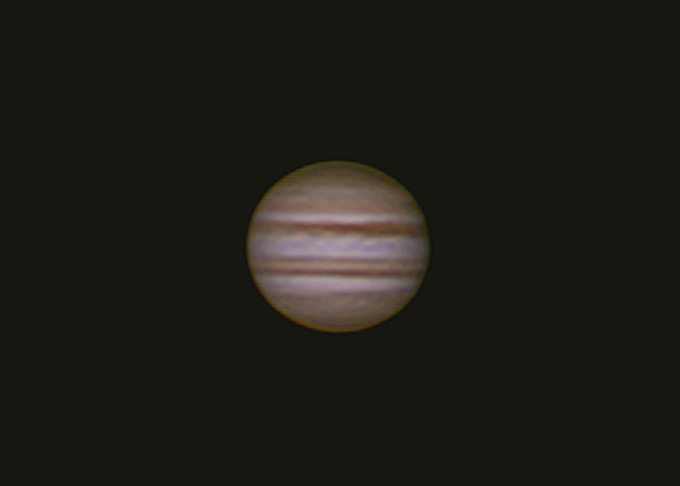
This picture was shot with my previous camera – check my new planetary photography set up and picture of Mars here and my best planetary shots.
Astrophotos with Orion 72ED Onyx – Winter 2008
Posted by jmeriaux in Astrophotography, Deep sky objects, Wide Field and Telephoto on May 24, 2009
I bought the Orion 72ED on the 2008 black Friday at Orion, at a bargain price. Overall I would recommend this scope for its portability and overall quality/price ratio.
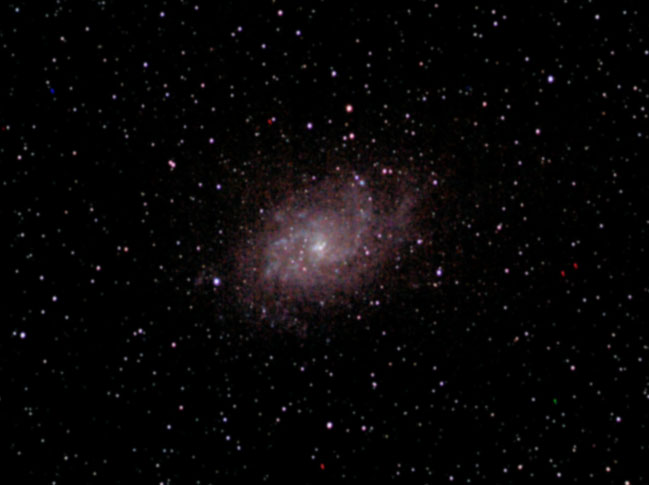
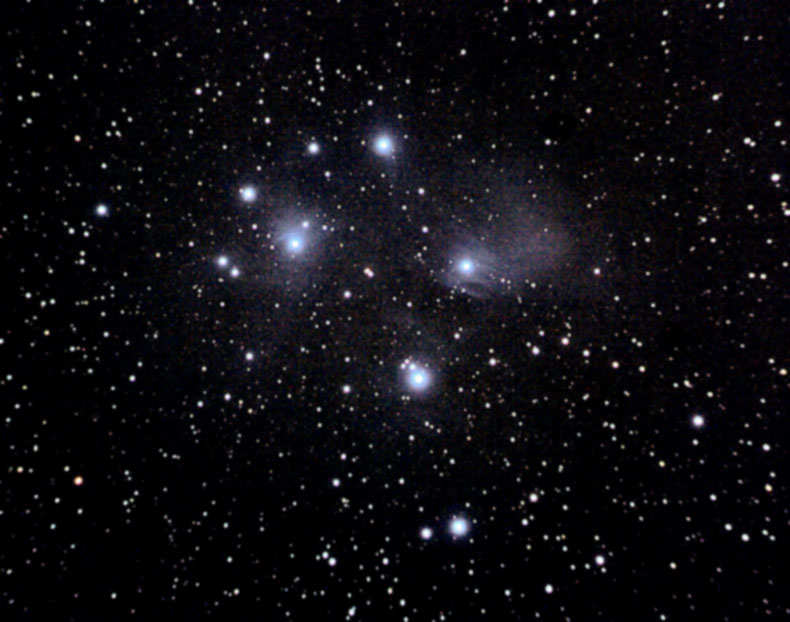
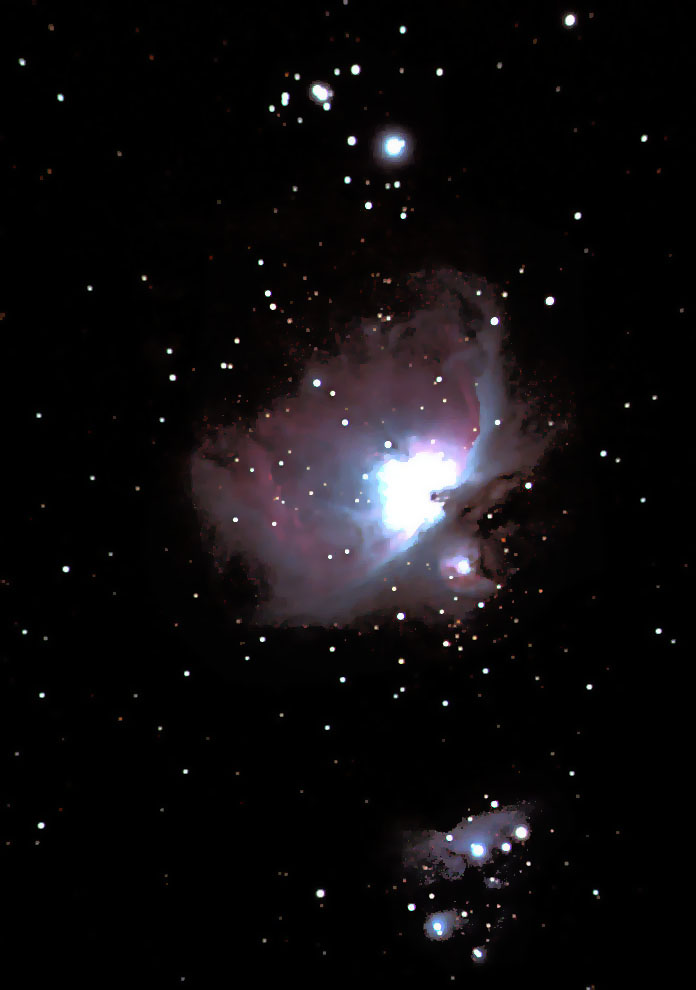
These pictures were taken without auto guiding, relying on the Mount polar alignment. I used a Celestron focus reducer for the M31 shot. Images have to be cropped – to hide coma on the edge.
DSLR: Non modified Canon XTi Rebel. Images processed with Max DSLR and Paintshop pro.
M33 – 5 exposures of 2 minutes each – 11/29/2008 – San Bruno – Orion 72ED
Pleiades – 11/30/2008 – 7 exposures of 2 min
M42 – 12 exposures of 2 min – 11/30/2008
Spring sky – 2009
Posted by jmeriaux in Astrophotography, Deep sky objects on May 24, 2009
Some pictures taken for San Bruno, CA – highly polluted site close from the SFO airport.
Telescope: Orion 102ED, with Canon XTi Digital Rebel, and Orion auto guider.
I used a Bahtinov Mask to focus the DSLR, and an Orion Skyglow anti-pollution filter. Pictures were processed with MaxDSLR and Painshop Pro.
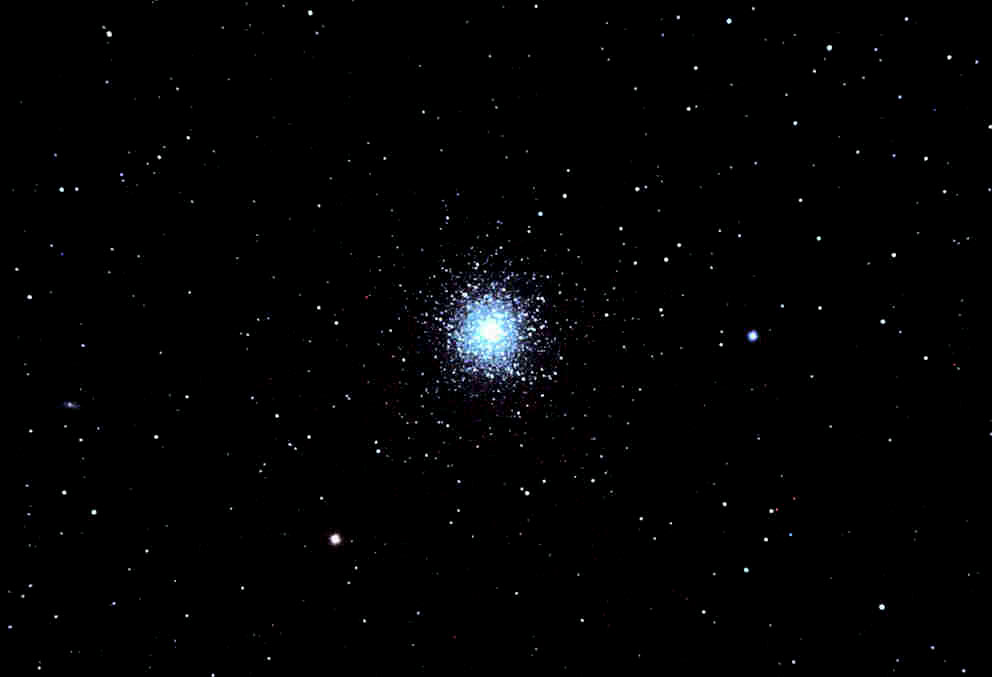
M13 – 5/17/2009 – Stack of 8 images – 90 sec. exposure
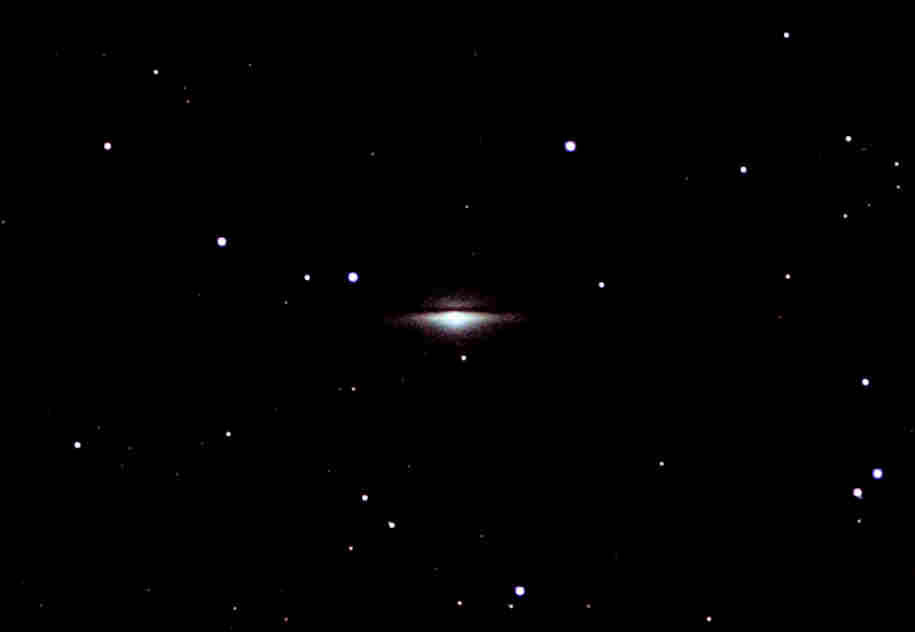
m104 (Sombrero Galaxy) – 5/16/2009 – Stack of 8 images – 2.20 min exposure
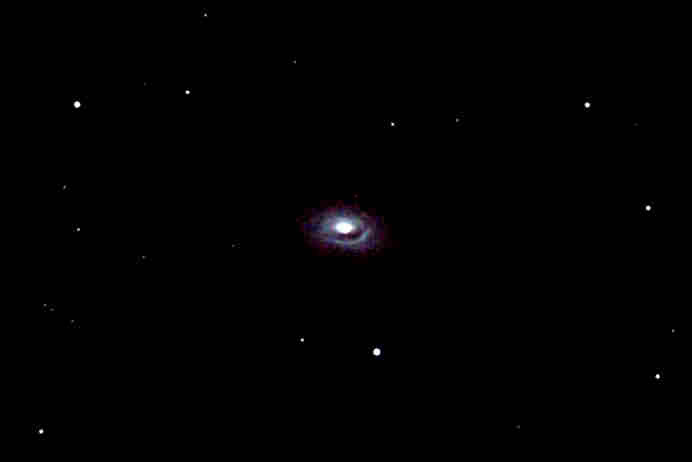
m64 – Black eye’s galaxy – 5/17/2009 – Stack of 7 images – 2.20 min exposure
Pictures of Messier 42 object under light polluted site
Posted by jmeriaux in Astrophotography, Deep sky objects on December 15, 2008
Astrophotography of deep sky objects is quite challenging in a highly light polluted area. The nearest dark site from where I live is a two-hour drive and I cannot really make it very often. That’s why I try out techniques to take Deep Sky Object pictures in light polluted site … Fortunately with DSLR cameras, light pollution Filters, and Image processing, there are some ways of making some interesting pictures. I’ll post my experiment and findings…
Given the name of this Blog, the place of honor should come to M42 – the “Great Nebula”. It is also a very easy object to work with. Even in a light polluted site it is (almost) visible with the naked eye.
I took Pictures of M42 with the Orion Eon 72mm and Orion 102ED. The pictures were taken from San Bruno, CA (near the San Francisco airport) and I used a light pollution filter (Orion SkyGlow Imaging Telescope Filters 2″) for the 102ED shots.
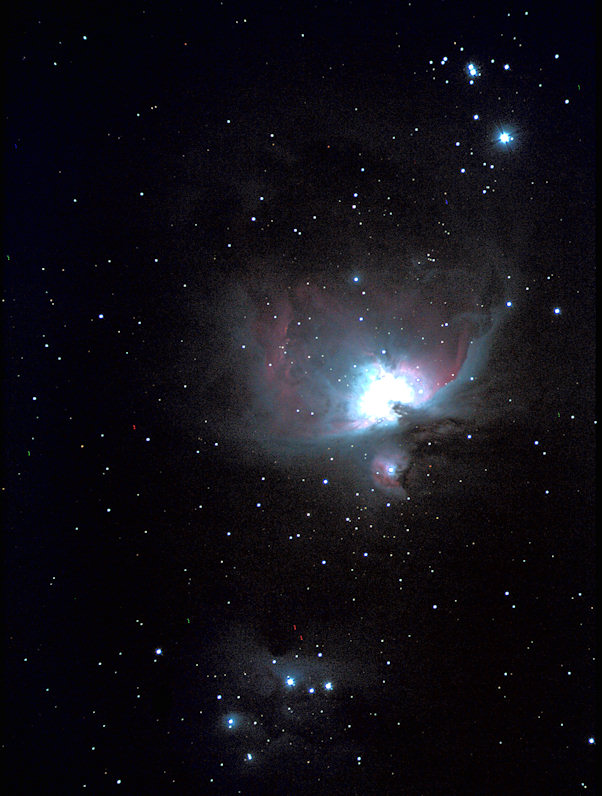
Orion M42, M43 and NGC1977 with Orion Eon 72mm
Taken on 11/30/2008 at 11.30pm PST: stack of 12 frames of 120sec each with Canon XTi – 400 asa – processed with Max DSLR and Corel Paintshop. With Corel Paintshop I used the “Histogram adjustment” and “Unsharp Mask” tools to increase contrast and brightness. The picture had to be cropped as the Eon 72mm shows some serious coma at the edge of the image… But for a $350 scope the result is not bad (black friday’s promotion at Orion). I am thinking of using it as a grab-and-go scope, a wide field astrophotography scope, and even for taking daylight pictures.
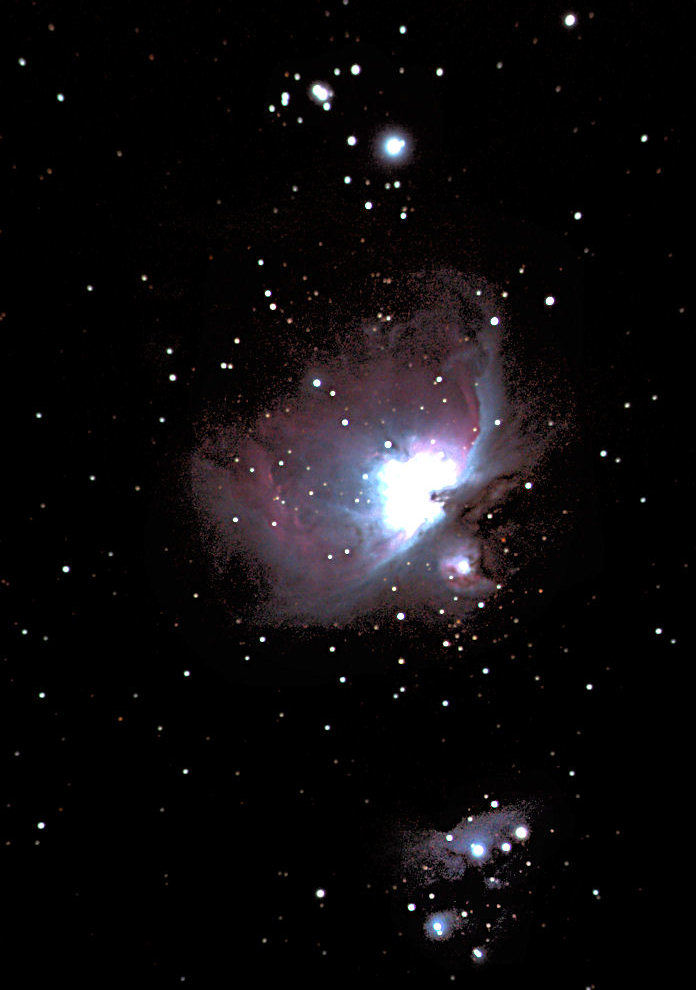
I used the mount tracking (Sirius EQ-G) – no guidescope. With such a short focal and short exposure time, guided scopes are not a hard requirement, if you do a great polar alignment of your telescope mount.
Orion M42, M43, and NGC1977 with Orion 102ED
Taken on 12/07/2008 at 2.45am – San Bruno, CA.
This picture was taken using the Orion SkyGlow Imaging Telescope Filters 2″. The background was definitely darker with the filter. Even though there are less pictures stacked than above with the Eon 72mm, the final result looks Ok and with more details than the shot taken with the Eon 72mm.
The picture is a stack of 4 frames of 164sec each with Canon XTi – 400 asa – processed with Max DSLR and Corel Paintshop. With Corel I used the “Histogram adjustment” and “Unsharp Mask” tools to increase contrast and brightness. The picture had to be slightly cropped but did not exhibit as much coma as with the Eon 72mm. I used the “Lasso” tool to selectively increase the brightness and contract of NGC 1977. I used the mount tracking (using a Sirius EQ-G) – no guidescope. I had to scrap 4 pictures out of 8 because either the tracking was not great or the focus was not good enough. The polar alignment has to be carefully done to take exposure of +160 seconds and does not guarantee well tracked images if you don’t use (as I did) a guidescope.
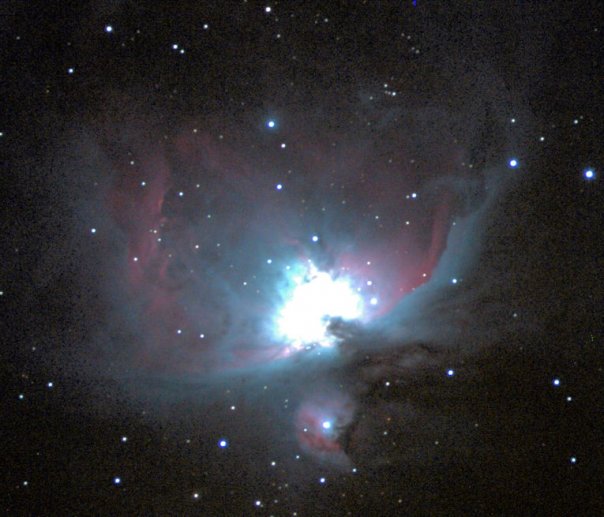
M42, M43 and NGC 1977 – Orion ED102
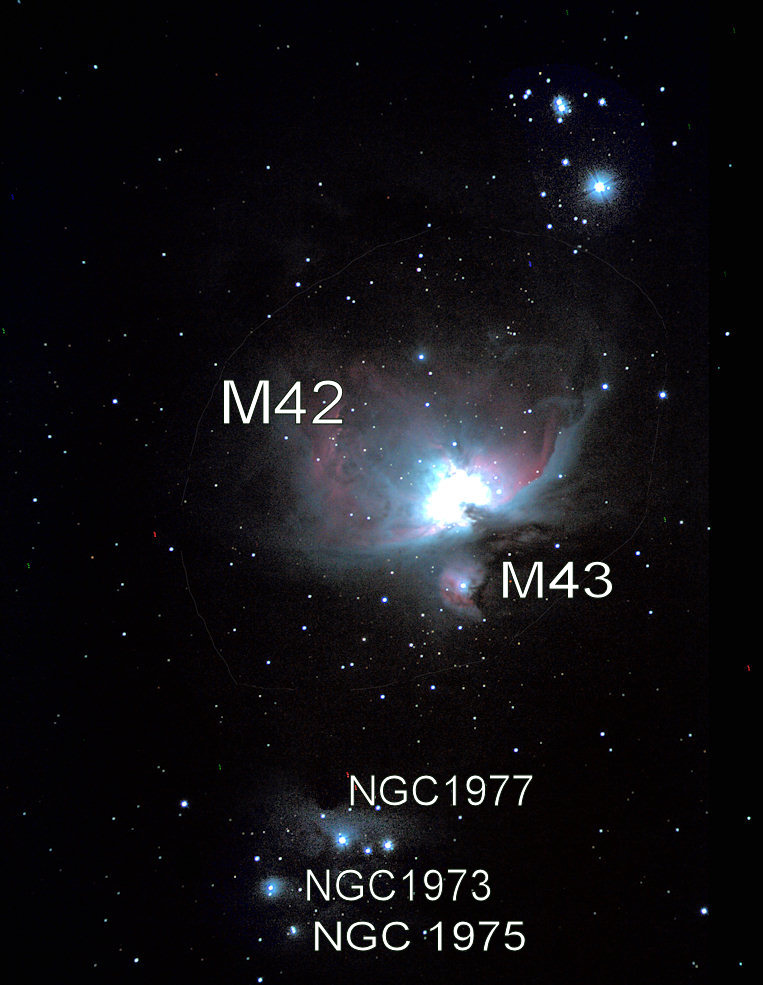
Same picture cropped – more details on M42 and M43.
Solar astrophotography
Posted by jmeriaux in Astrophotography, Sun on November 26, 2008
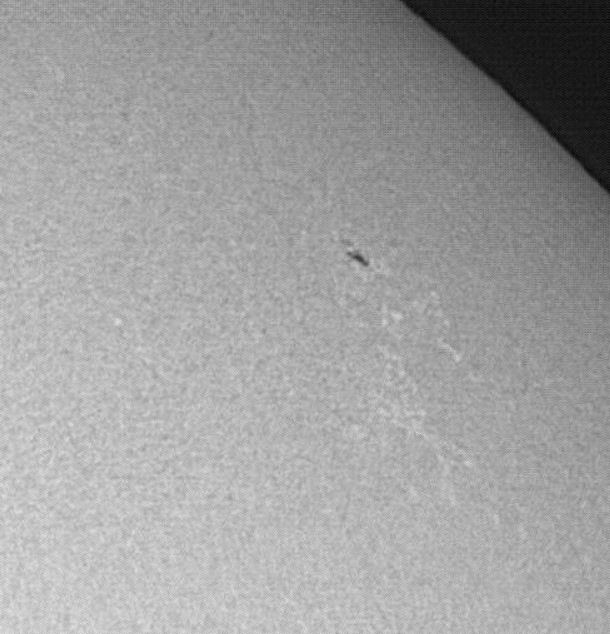
With the home made solar filter I made with the baader solar film I took some pictures of the sun, with my Orion StarShoot Solar System Imager II and the Orion 102 premium refractor on the 11/15/208 at 11.15 am PST.
Solar activity is not great these days, making things more challenging … I can remember days where giant sunspot complex where visible with the naked eye.
Shooting the Sun with a Solar filter is not an easy task. Dust speckles on the digital camera show up as you can see here on the below picture – at the right of the sun spot.
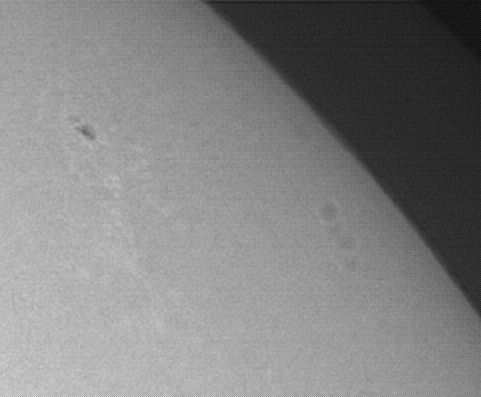
It is critical to take flat field pictures and use software like Max DSLR to substract the flat field image from the Sun spot pictures to get higher quality images.
After image processing here is the result. Notice the granulae, sun spot, and faculae around the (small) Sun spot.
 Astrophotography in Urban Environment
