Archive for category Deep sky objects
New Mexico Sky: Orion with Canon XTi and Astrotrac
Posted by jmeriaux in Astrophotography, Deep sky objects, Wide Field and Telephoto on September 27, 2010
Another post on the pictures I took during my vacation in Abiquiu, NM – to escape the light dome of the San Francisco Bay area.
Pictures taken with the Astrotrac Travel system, without autoguiding. For perfecting the North Pole alignment, I used the DSLR Logger Shareware.
The Lens I used in this post were the Canon 50mm f/d 2 – a cheap lens – but doing a nice job when in focus… And the Canon 200mm L – a great lens for Astrophotography.
The Camera was my modified Canon XTi. I took other pictures (see previous post) with my Qhy8 CCD camera.
Barnard’s Loop with Canon 50mm and Canon XTi
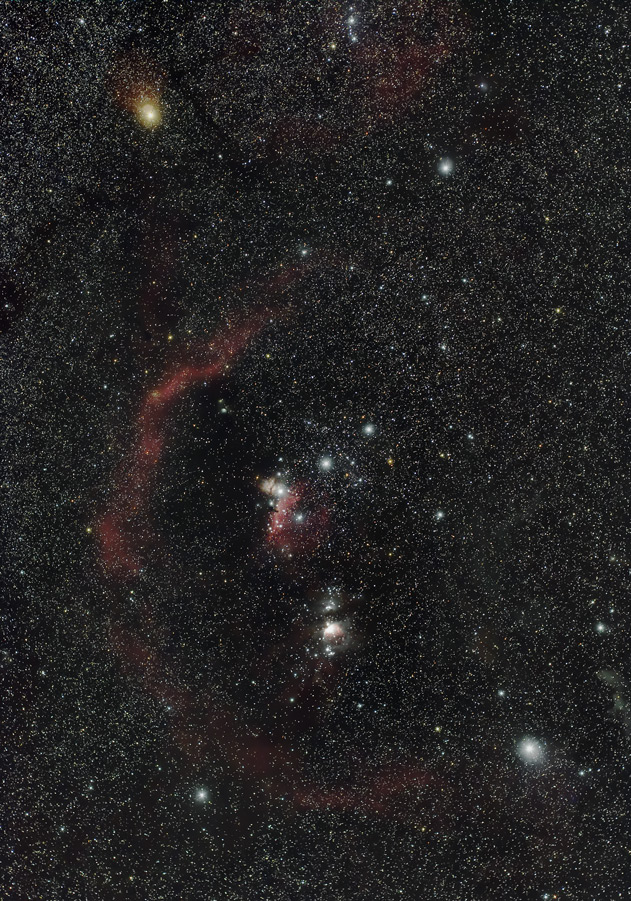
Orion was low on the horizon, even in the morning, but it was hard for me to resist taking shots of the great nebula in such a beautiful sky.
I was not able to see Barnard’s loop with my naked eye but shooting it was fairly easy.
Pictures were taken with my modified Canon XTi and Astrotrac travel system. The modified camera certainly does an easier job in capturing the light of this faint emission nebula.
This is a combination of 6 exposures of 5 minutes.
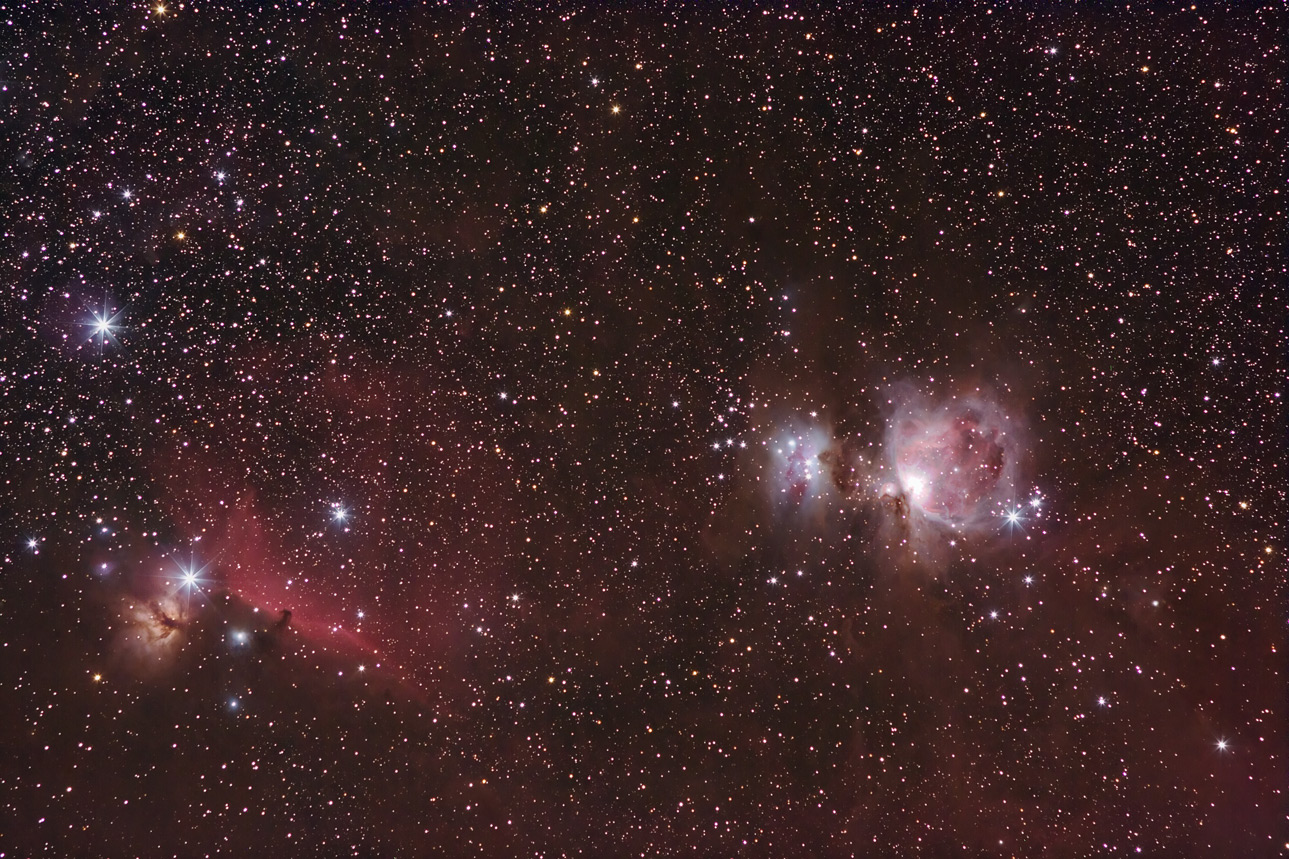
The Great Nebulae,horse head and Flame nebulae with the Canon 200mm and Canon XTi
This is an overall picture of the horsehead and m42 region with the Canon 200m L lens at f/d 3.5.
Even if the pictures are not perfect on the corner I found one more time the performance of the teleobjective very impressive.
Focus might have been slightly better since I have some level of elongated stars on the corner – which is I found a symptom seen when the focus is very slightly off. But having a focus with the DSLR at this high speed focal ratio is challenging…
This is a combination of 18 exposures of 3 minutes with Dark frame, Biais, and Flat frame reduction.
Note the nebulosity below the horsehead and m42 are not light pollution but rather extensions reaching the barnard’s loop….
Disturbing at first for somebody like me who is used to take shot from light polluted sites -and who is usually dealing with gradient from the light pollution!
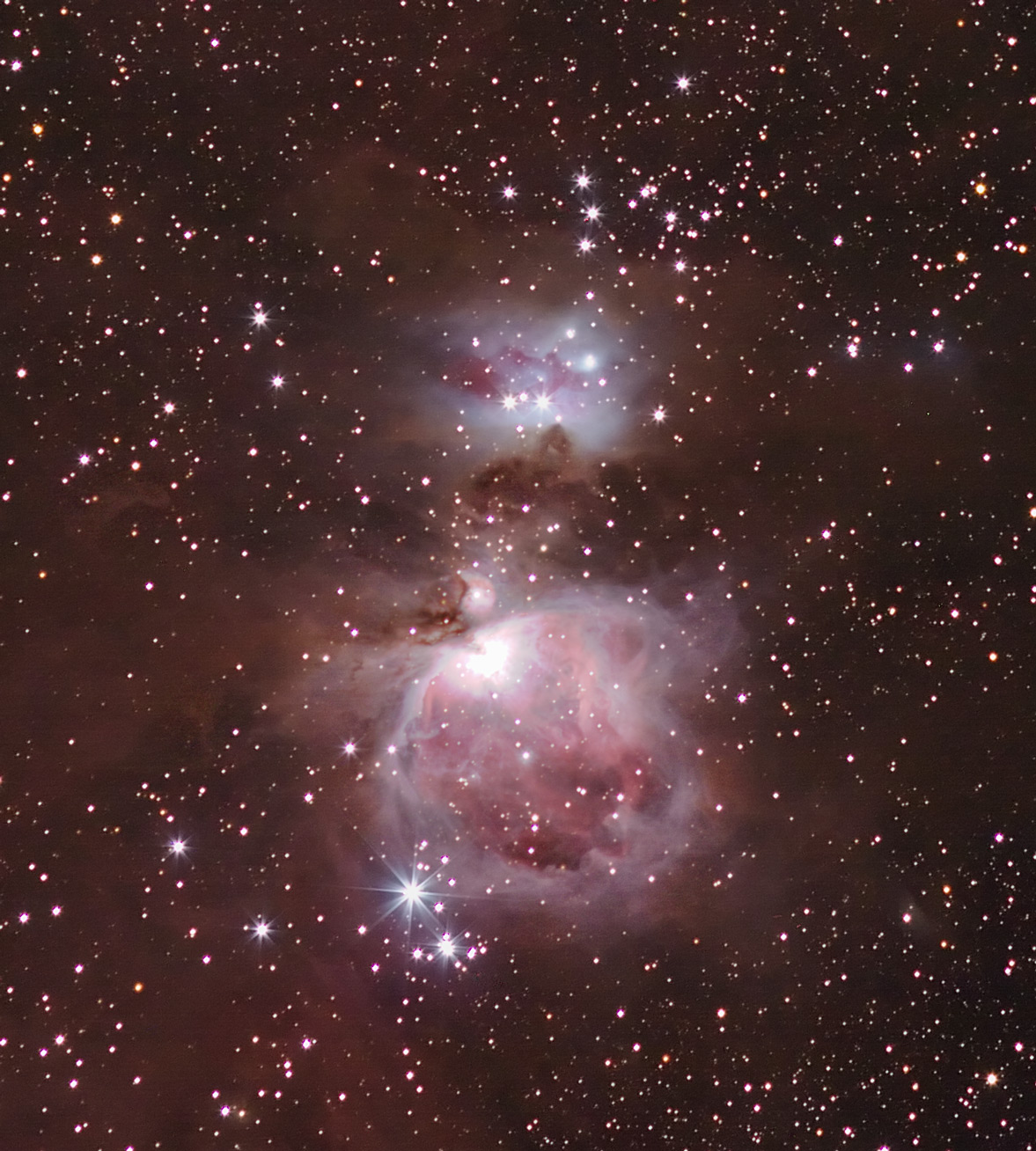
This is a cropped picture of M42 – even cropped the image reveals lots of details.
Notice the fine details of the Nebulosity extensions on the left between the great nebula and the running man nebula…
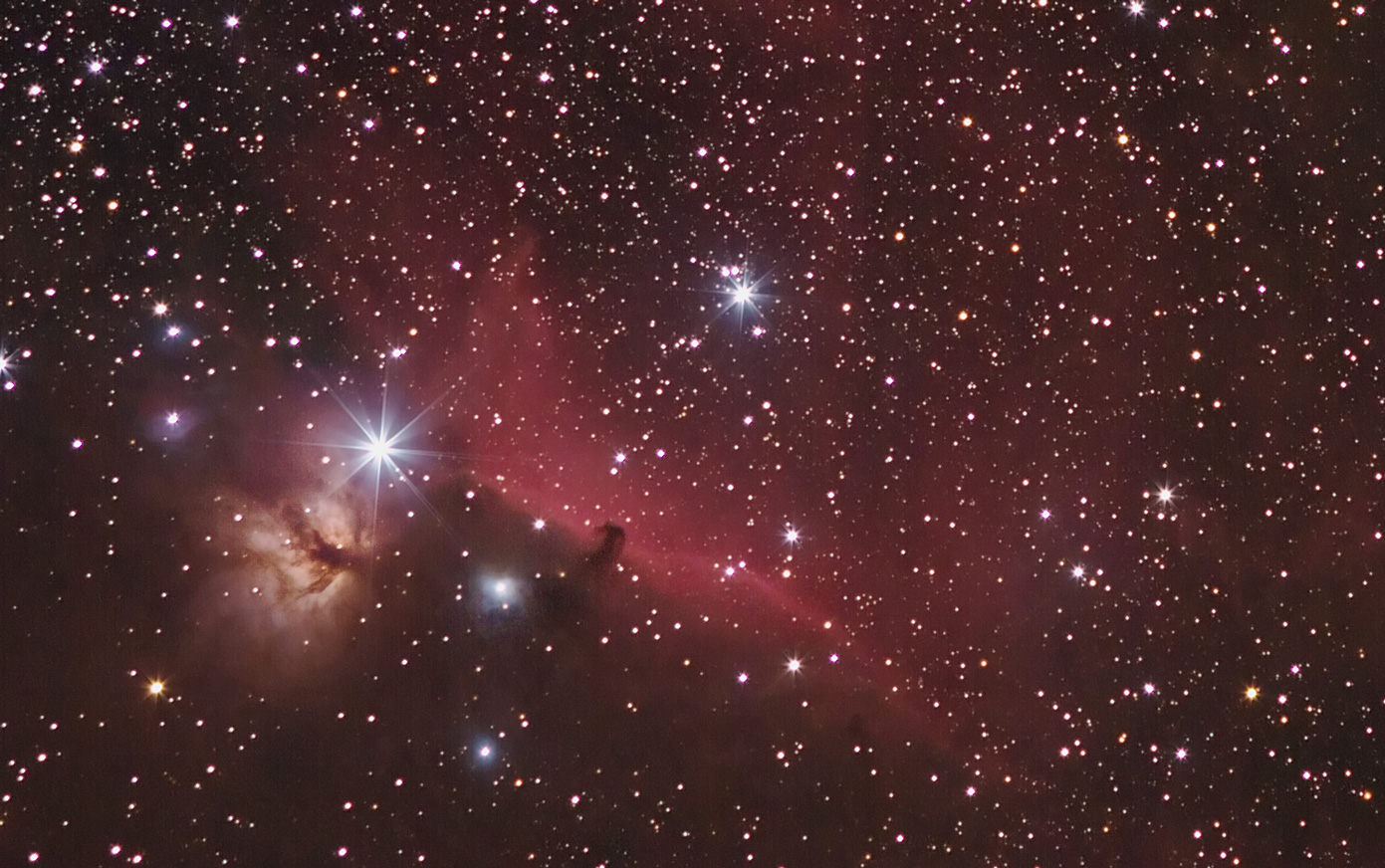
Last, the Horsehead and Flame Nebulae … still crop of the same picture.
New Mexico Sky: America and Pelican Nebulae with Astrotrac and Qhy8
Posted by jmeriaux in Astrophotography, Deep sky objects, Wide Field and Telephoto on September 18, 2010
I was able to escape from the Bay area light dome and spent two weeks in Abiquiu, NM, where I used extensively the Astrotrac Travel System with a set of good Canon teleobjectives and my Takahashi fs60-c.
I’ll post most of the pictures I took – but I was very satisfied with the performance of the Astrotrac for unguided wide field photography.
Photographies were taken either with a modified Canon XTi, or with a Qhy8 CCD coupled to the Teleobjectives.
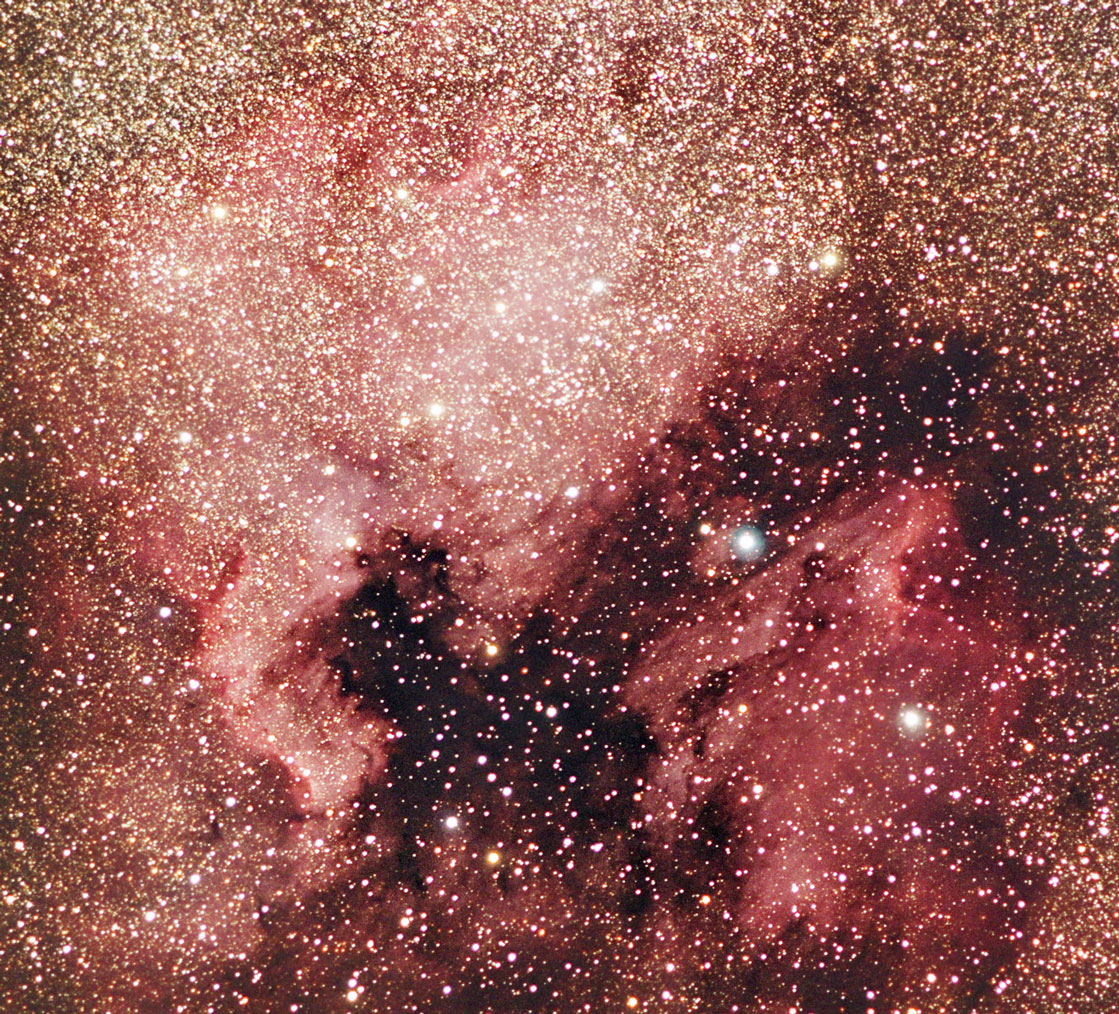
Here is NGC 7000 and the Pelican Nebulae with the Canon 200mm f/d 2.8 L Teleobjective and the Qhy8 CCD camera.
It is a combination of 27 exposures of 2 minutes, processed with Dark, biais, and Flat frames.
When coupled with the CCD it is not possible to control the F/D ratio of the Teleobjective, but at f/d 2.8 the lens performance is still honorable and shows sharp stars.
I was able to observe the Qhy8 does a slightly better job in capturing faint details of the nebulae. I suspect it is due to the pixel size of the Qhy8 sensor (7.8 microns). This is about 50% larger in area compared to the Canon XTi sensor, and captures in theory 50% more photons by pixel in the same exposure time for extended objects like nebulae.

Below is the cropped image showing details of the Anerica and Pelican Nebulae. As you can see the image is still full of details when magnified.
Combining 27 frames contributes a lot in increasing the signal/noise ratio. Focus has been done using the real time view of the CCD, and here again advantage for the Qhy8 compared with the Canon XTi. Focus is done by looking in real time at the Full Width Half Maximum measurement on a bright star – and allows a very precise focusing – which is not a small feat at f/d 2.8.
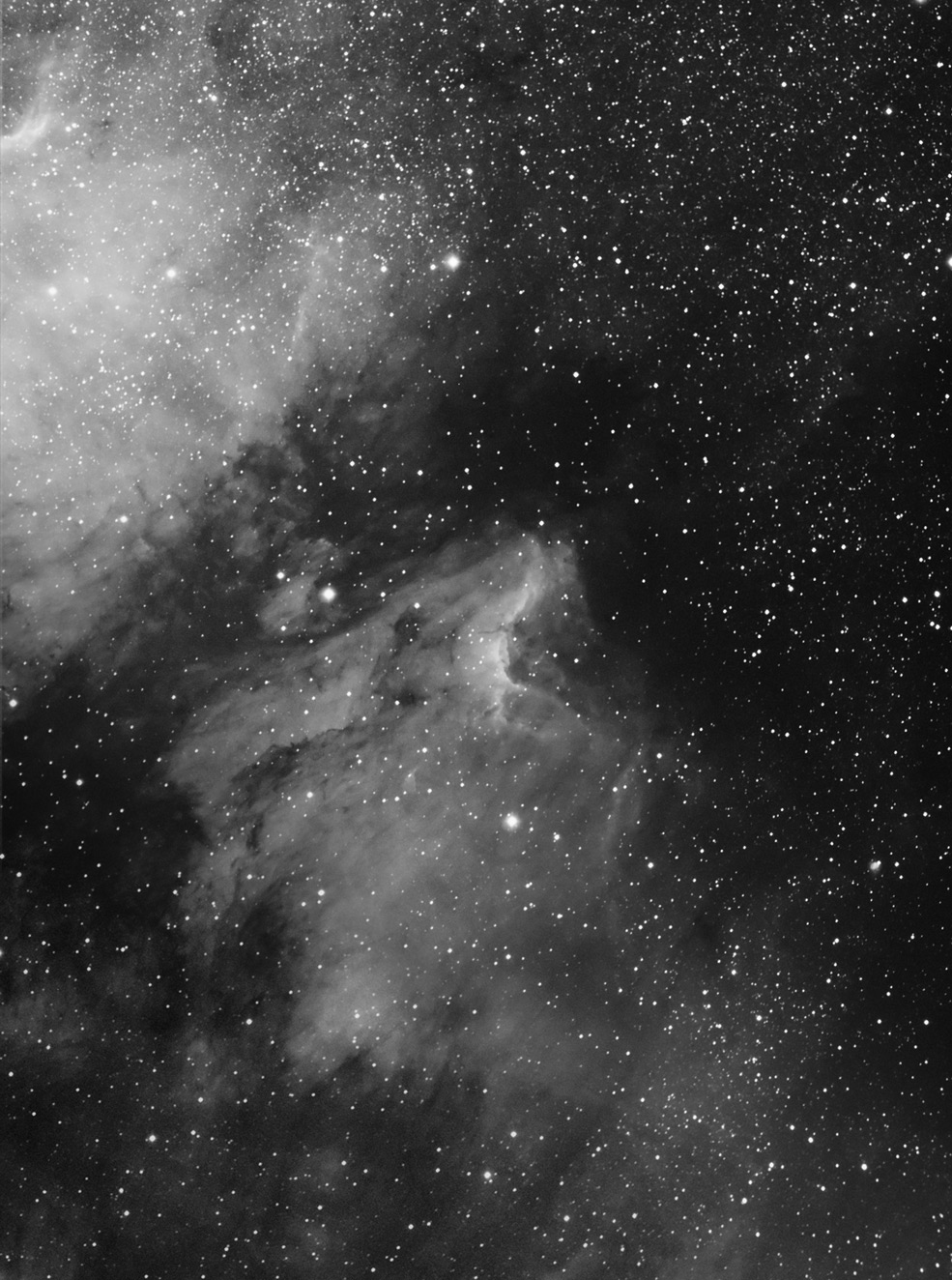
Pelican Nebula in HAlpha wavelength
Posted by jmeriaux in Astrophotography, Deep sky objects on August 31, 2010
Date: 7/31/2010
San Bruno, CA
Takahashi FS-60C with Qhy9 CCD, HAlpha 12nm Astromik Filter and Astro-tech field flattener.
Auto-guided with 50mm Finder turned into a guidescope and Orion startshoot autoguider
9 exposures of 420sec taken under Moonlight (77% illumination). Thanks to Narrowband imaging, it is possible to do long exposures under light pollution and moonlight illumination…
M17 with Canon EF 200mm f/2.8 L II and Astrotrac
Posted by jmeriaux in Astrophotography, Deep sky objects, Wide Field and Telephoto on August 15, 2010
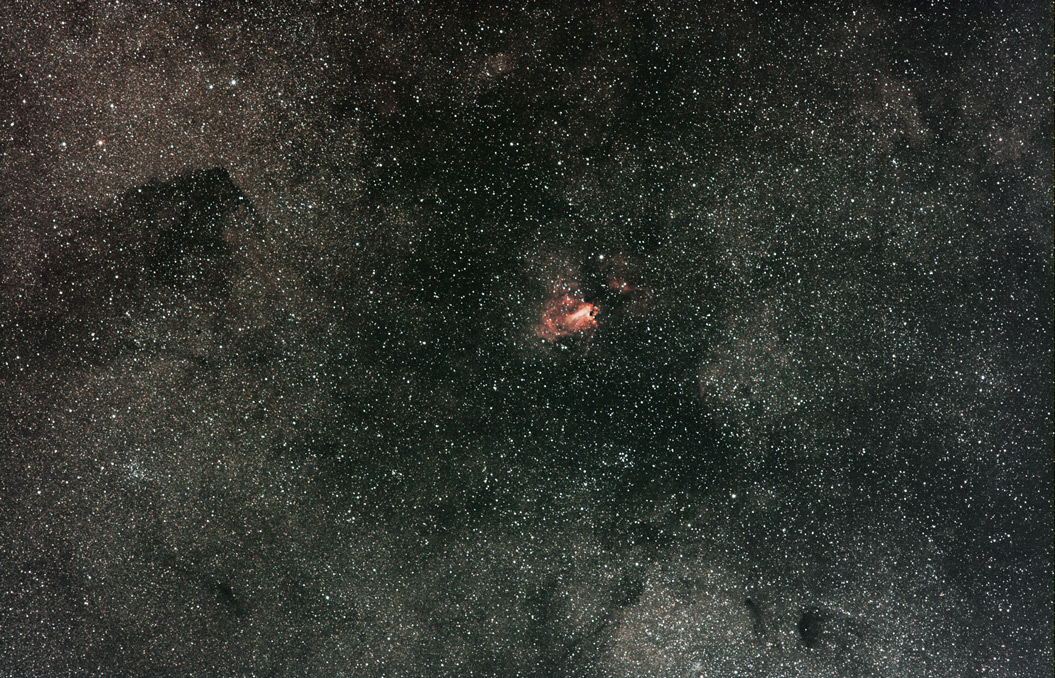
Date: 8/9/2010 – San Bruno, California – near the SFO airport
Transparency: 3/6 – Wind between 5mph and 10mph
Mount: Astrotrac travel system
Camera: Modified Canon XTi (Standard IR filter replaced with an astrodon IR filter by Hap Griffin) with Canon 200mm f/d 2.8 teleobjective (prime lens) opened at f/d 3.5 – at Iso 400.
22 exposures of 90 seconds with Astronomik CLS CCD clip filter, 10 flats frames, 10 darks, 10 biais.
Full Frame
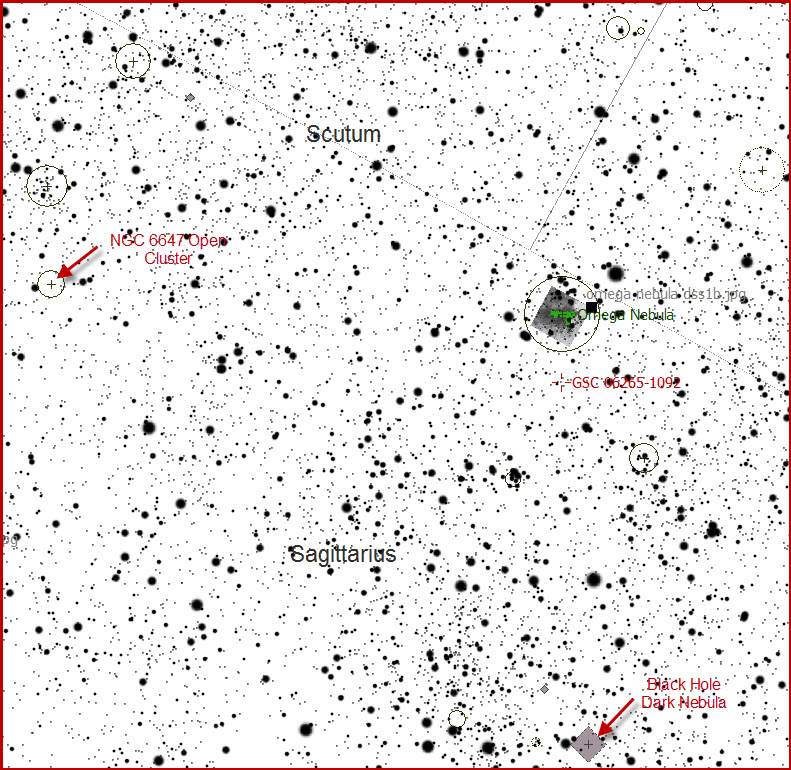
M17 Area – Skytools v3
Cropped Frame centered on M17
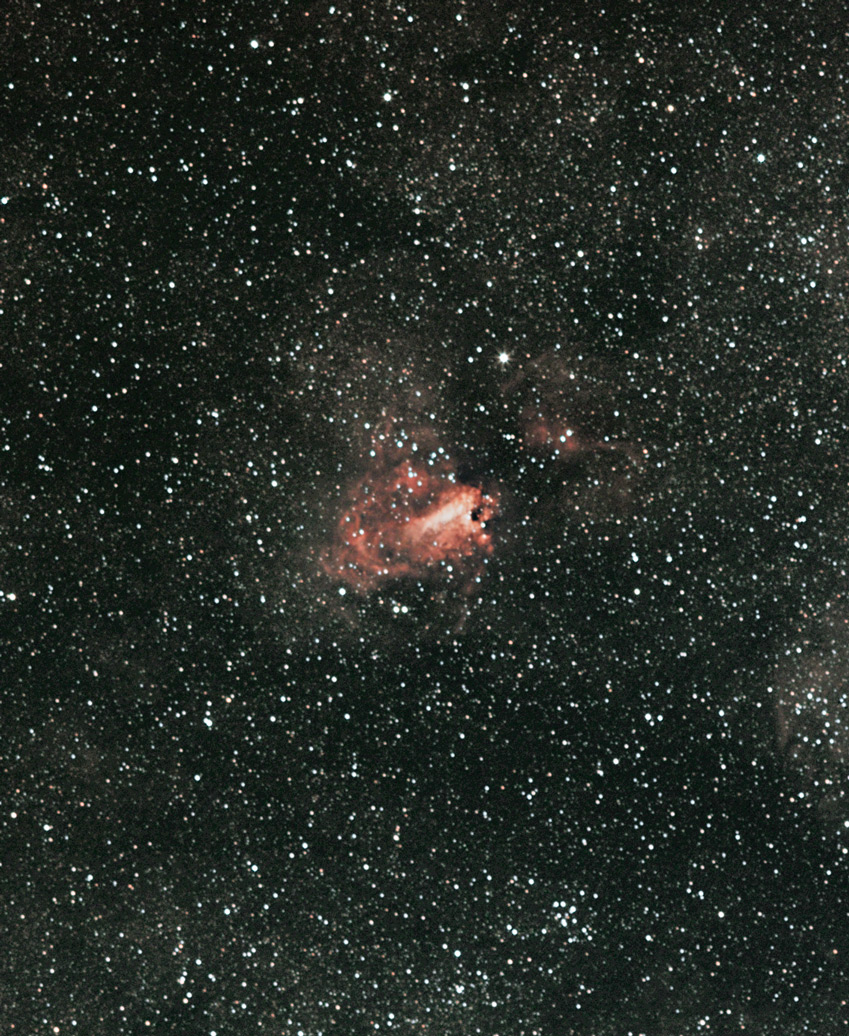
Processing:
- MaximDL5: darks and flats subtraction, alignment and averaging
- Photoshop CS4: stretching, selective sharpening
- Noise Ninja: noise removal
I used a Bahtinov mask as a focus help on a bright star (Antares).
This is important to use a bright star when using the Bahtinov mask, to have the right in-focus diffraction pattern.
Note that at f/d 3.5 the focusing tolerance is +/- 7 Microns! See Thierry Legault’s site on this topic.
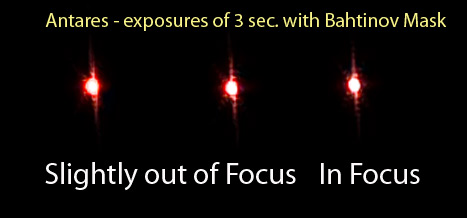
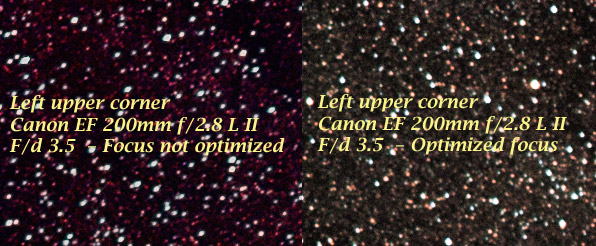
Interestingly, having the canon not perfectly in focus elongates slightly the stars on the frame edges.
I initially thought the lens was the culprit and using it at f/d 3.5 was “too fast”.
In fact, by having an optimized focus the stars are round on the whole frame! See below – pictures are at 100% size.
Lagoon and Trifid Nebulae: second try
Posted by jmeriaux in Articles, Astrophotography, Deep sky objects, Wide Field and Telephoto on August 7, 2010
Date: 8/1/2010 – San Bruno, California
Mount: Astrotrac travel system
Camera: Modified Canon XTi with Canon 200mm f/d 2.8 teleobjective (prime lens) opened at f/d 3.5 – at Iso 400. Installed on a tripod collar ring and a Manfrotto ball head.
32 exposures of 90 seconds with Astronomik CLS CCD clip filter, 12 flats frames, 10 darks, 10 biais.
For Flat fields I use an electroluminescent panel from Glowhut. This is by far the best way I found to take flats that “work” in a consistent way.
This is my second try at this with the same set up. I got much better results this time…. Even though it is taken from my backyard where usually magnitude 3 stars are barely seen. Transparency was a little bit better than usual – I would say between 3/6 and 4/6 (magnitude 3.5 stars seen at best) and M8 was quite low (below 30 deg.) so imaging was still a challenge!
The big difference with my previous posting is that my Canon XTi has been modified (Standard IR filter replaced with an astrodon IR filter by Hap Griffin) – and the response of the camera in the Red and especially HAlpha wavelength is much better…
Also this time I made sure the astrotrac polar scope had a centered reticule for better polar alignment.
I used the sane CLS CCD anti pollution filter, same digital processing, and same exposure time as in my previous try. The Astronomik CLS CCD works wonderfully with the modified Canon.
But this time I also used an “X-Tend a Sight mount” from Photosolve along with an Orion EZ Finder. It really helps to find and approximatively center the objects in the canon 200mm field of view since seeing stars through the Canon XTi is almost impossible. Then I take a short shot and re-center the object.
In addition I used a Bahtinov mask as a focus help. Focusing the Canon 200mm open at f/d 3.5 is really hard: in a fraction of a turn stars get out of focus. I found the mask to be of some help in getting more consistent results (even though you do not obtain the usual diffraction patterns you observe when focusing a telescope with the mask).
Processing:
- MaximDL5: darks and flats subtraction, alignment and averaging
- Photoshop CS4: stretching, selective sharpening
- Noise Ninja: noise removal
M8 and M20 – Canon 200mm Teleobjective and Modified XTi

Details of M8/M20- Cropped image
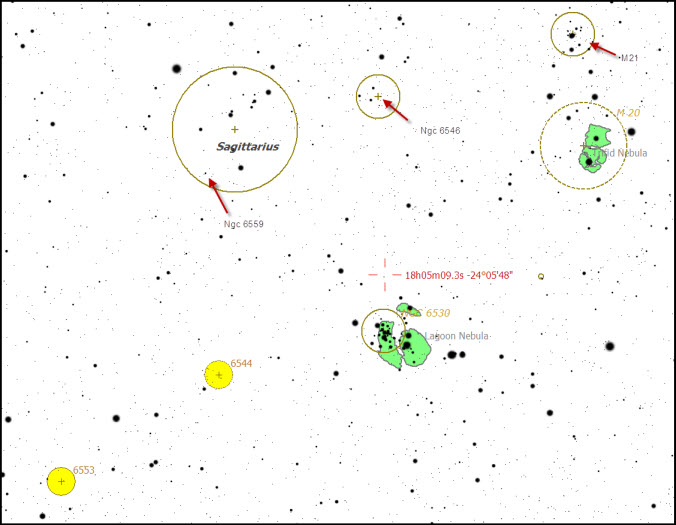
The following objects can be seen in the field of view: M8, M20, M21, diffuse nebula Ngc6559, globular clusters Ngc 6544, Ngc 6553, open clusters Ngc 6530, Ngc 6546
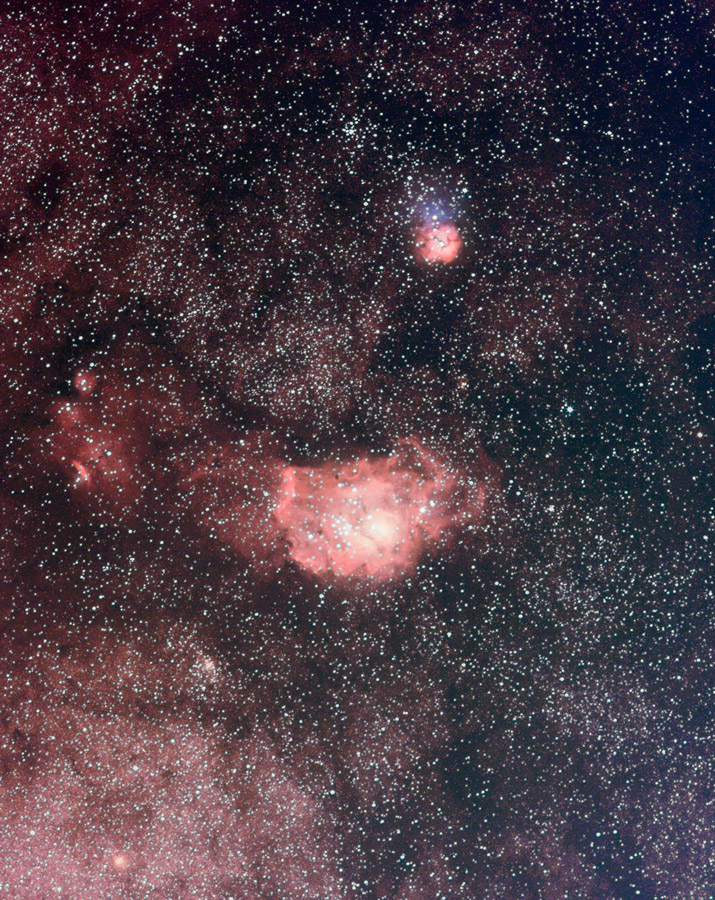
Skytools 3 Atlas
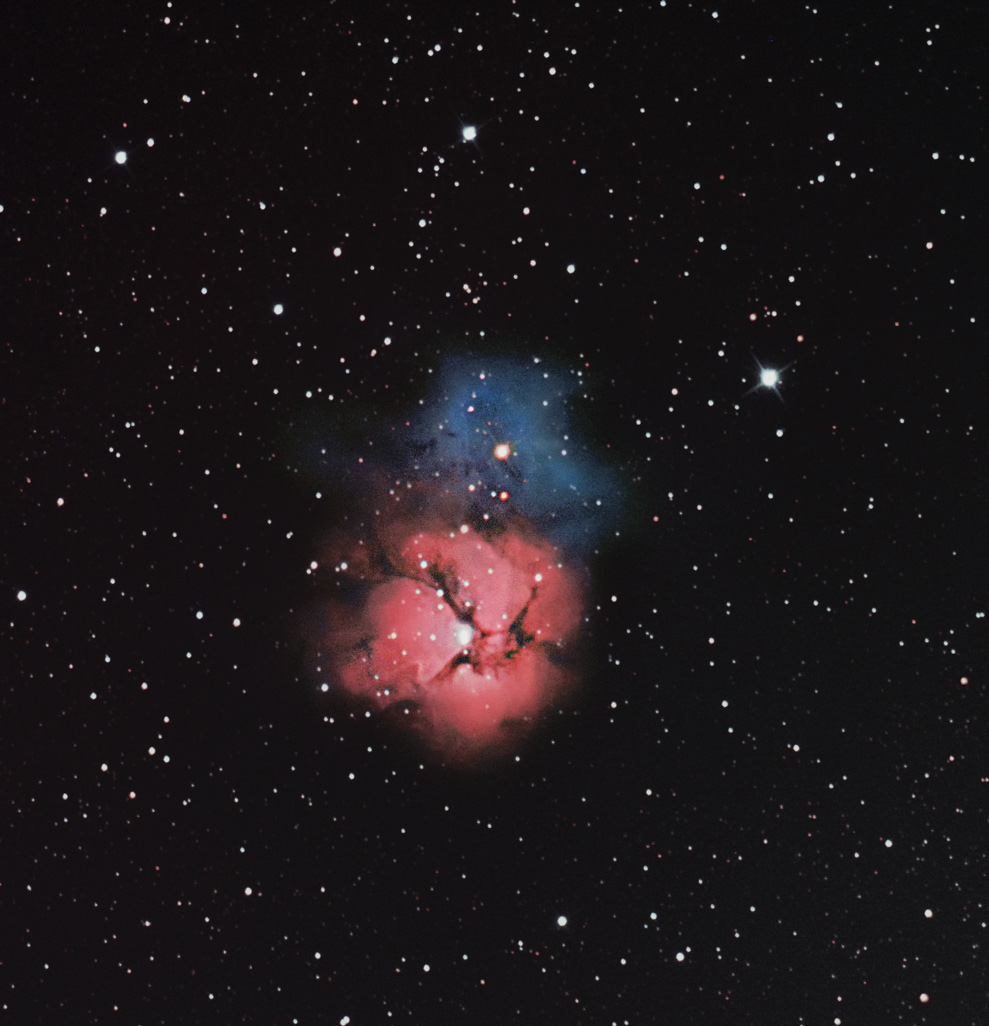
Trifid Nebula with 8″ Orion Newtonian Astrograph
Posted by jmeriaux in Astrophotography, Deep sky objects on July 24, 2010
Date: 7/4/2010
Seeing 3/10 – Transparency 3/6
8″ Orion Newtonian Astrograph with Baader MPCC on Atlas mount
Autoguiding with Takahashi fs60-c and Orion auto-guider
Camera: Qhy8 with CLS CCD – 11 exposures of 360sec
Trifid is quite low on the horizon (about 30 degree) – and being right in the middle of the city with the SFO airport not very far, the sky glow and turbulence makes imaging quite challenging.
Especially the blue of the reflection nebula is quite hard to isolate from the overall noise – that’s why it is necessary to stack many images to improve the signal to noise ratio.
But thanks to the CLS CCD astronomik filter, and processing with Photoshop CS4 and Noise Ninja, the final image looks acceptable.
Having tested the Coma Corrector from Baader with the Orion 8″ astrograph, I can now tell that once the collimation is perfect (at f/d 4 collimation tolerances are very small), the Baader coma corrector does a great job to obtain round stars across the image, at least for an APS-C size sensor like the one the Qhy8 has.
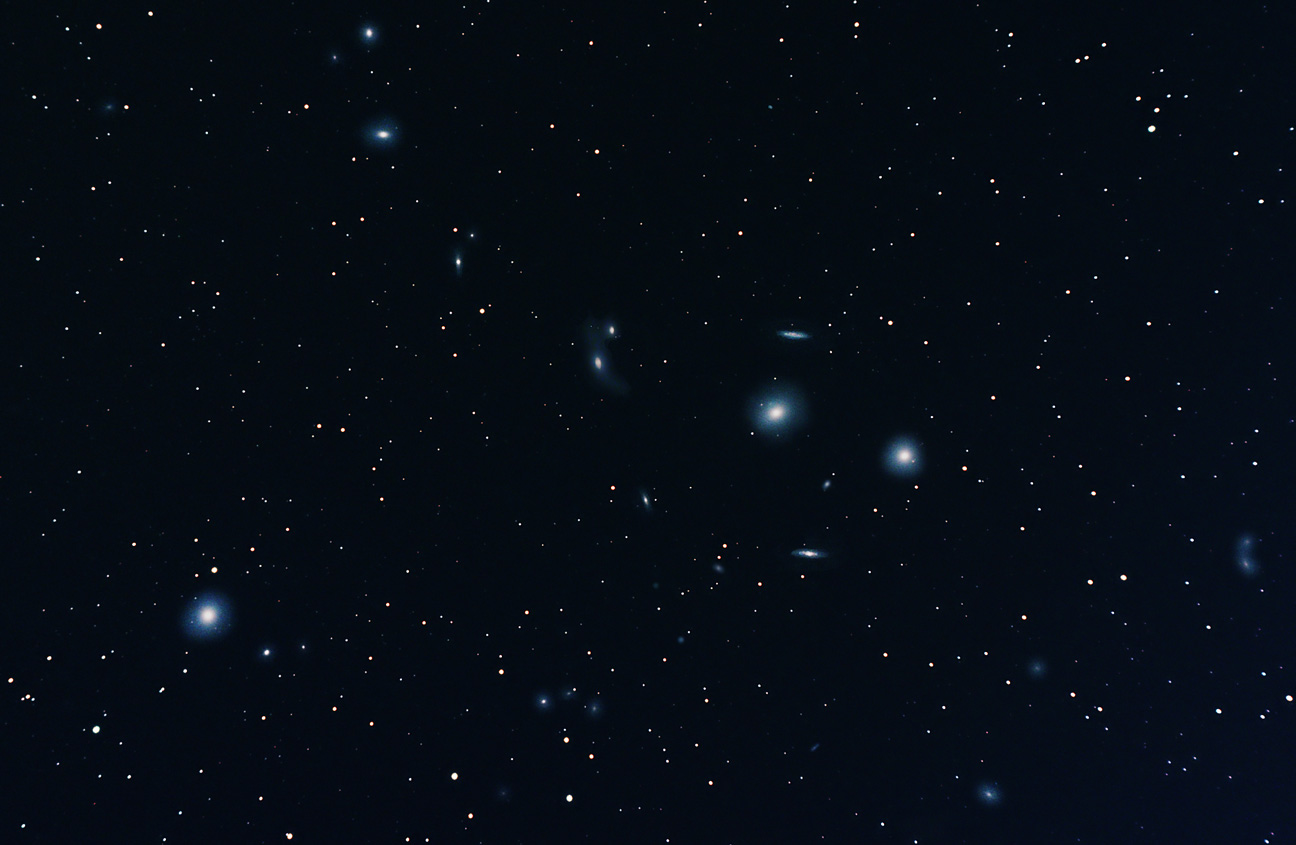
Markarian’s Chain with Takahashi FS60-C and Qhy8 Camera
Posted by jmeriaux in Astrophotography, Deep sky objects on July 21, 2010
Date: 6/11/2010
Telescope: Takahashi fs60c with Astrotech Field Flattener – Guidescope orion 102ed
San Bruno, CA
12 exposures of 420sec with Qhy8 CCD and CLS CCD – Seeing 4/10 – Transparency 3/6
Processed with Maxim DL5, Photoshop CS4 and Neat image.
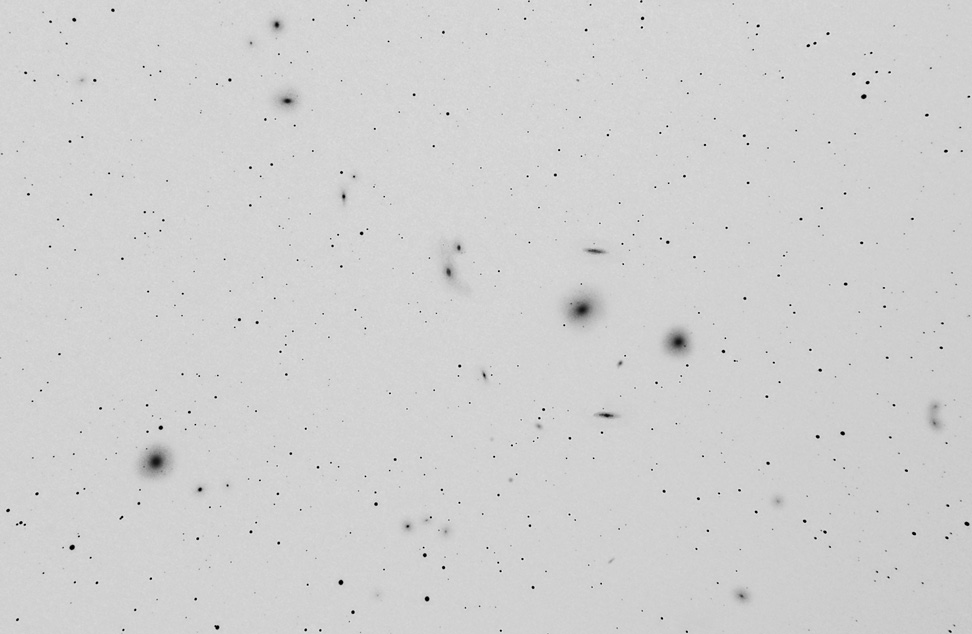
Negative
 Astrophotography in Urban Environment