jmeriaux
This user hasn't shared any biographical information
Homepage: http://ngc1976.org
First pictures with Orion 8″ Newtonian Astrograph
Posted in Astrophotography, Deep sky objects on May 9, 2010
I recently acquired the 8″ orion Newtonian astrograph for a couple of reasons:
- Fast focal ratio telescope to reduce exposure time
- Great capabilities given the price – it compares well with a SCT of same aperture but provide a faster optic
- Large field of view compared to instruments of similar diameter
- Lightweight and easy to set up (compared to larger focal length Newtonian)
I use the Astrograph with a Coma corrector (Baader MPCC – Multi purpose coma corrector) – this is a must be accessory for a Newtonian with such a high speed focal ratio. The telescope needs to be thoroughly collimated – but when you get used to it this takes a couple of minutes (first cut with laser collimator and fine tuning on a star).
Look also at the Trifid nebula shot I recently took with the 8″ Newtonian and qhy8 …
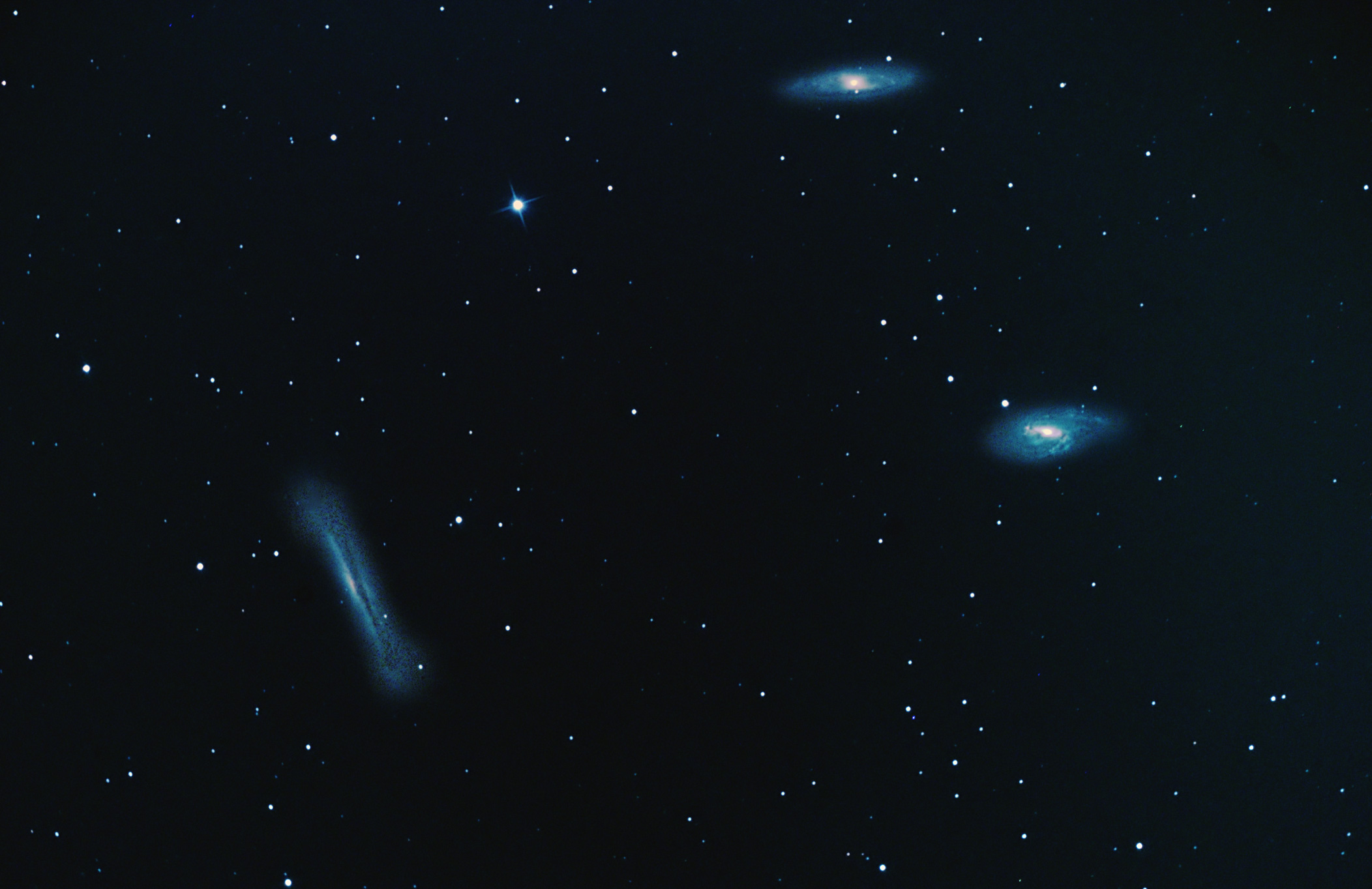
Leo’s triplet – 3/19/2010 – 9 exp of 360sec with Qhy8 CCD
This instrument is not meant to be a visual telescope (at least for Planetary observing). I can notice some spherical aberration on mine – but it is not a big deal for deep sky photography at focal plane (at least for the average conditions I have on my observation sites).
This telescope excels in Nebula and Galaxy clusters. For planetary nebulas , or details in small galaxies, a larger focal (e.g. the one you have with a C9.25″ at f6.3) performs better.
I used a couple of time CCD inspector from CCDWare with it to optimize the collimation. This is a fantastic product allowing you to collimate the telescope in real time while the CCD camera is attached to it. You do a rough collimation first – and then fine-tune the collimation with CCD inspector in real time. It can be used with any telescope, but this program is particularly useful with fast telescope where collimation has to be done within high tolerances.
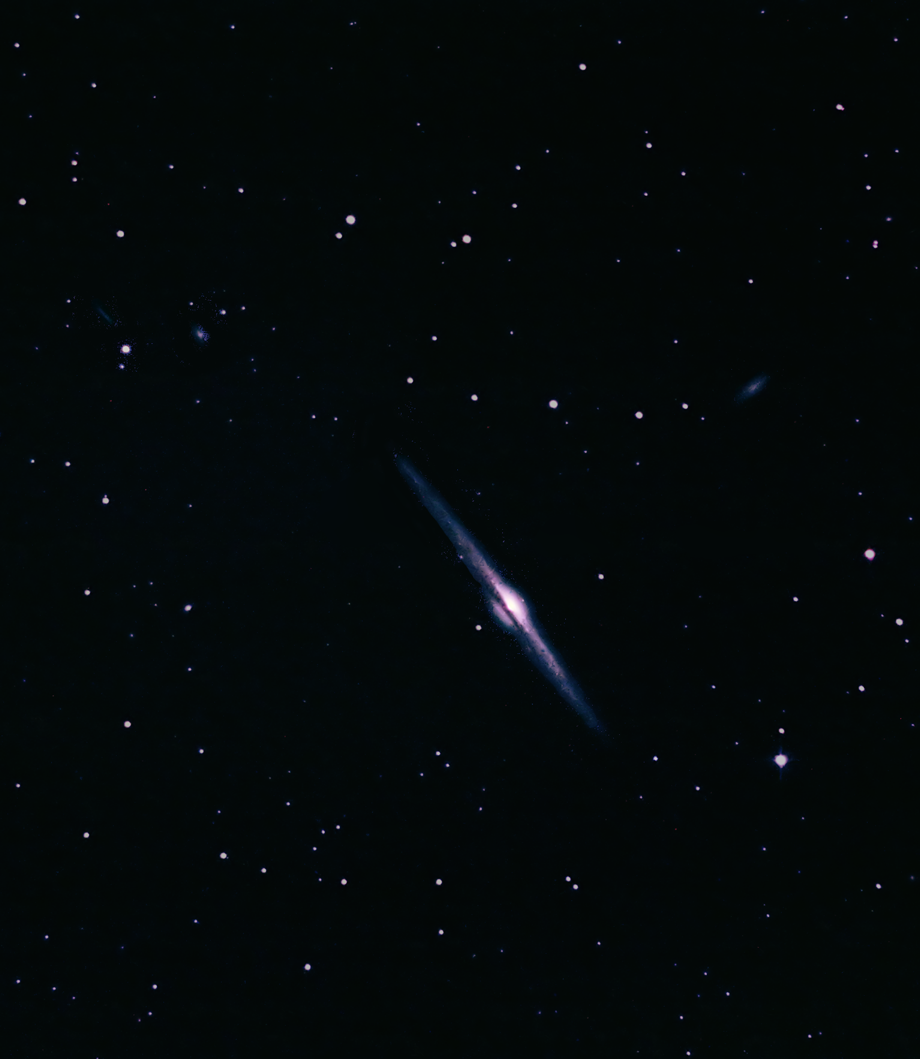
Ngc 4565 – Needle galaxy – 3/6/2010 – 19exp of 165 sec – Canon XTi
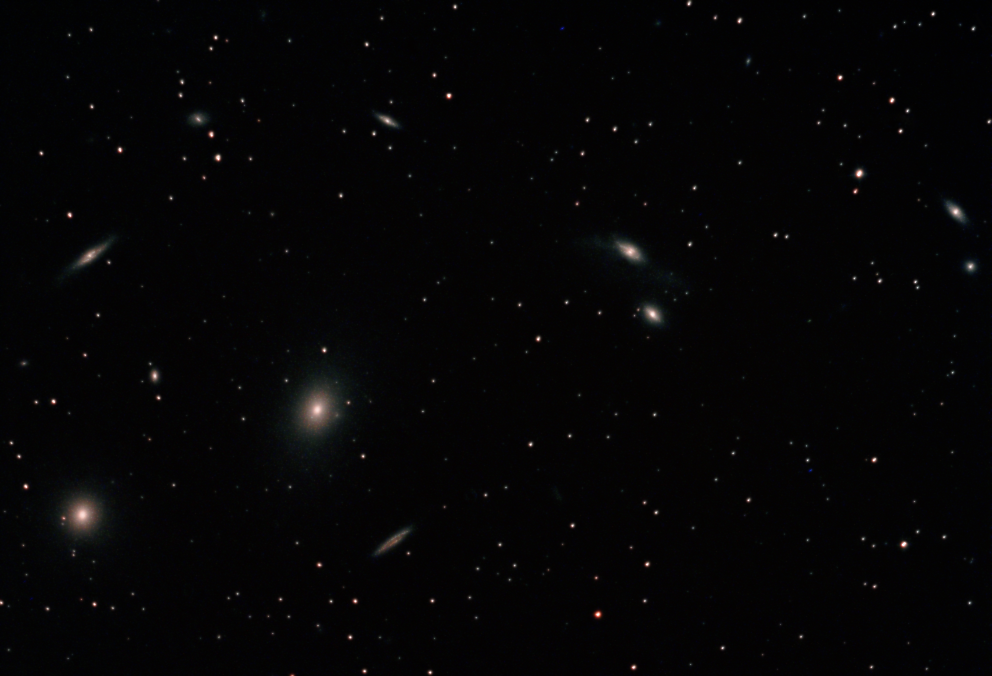
M86 – Part of Virgo Galaxy cluster – 5/6/2010 – 18exp of 360 sec with Qhy8 CCD
(collimation was far from perfect there … stars become donuts on the egde..)
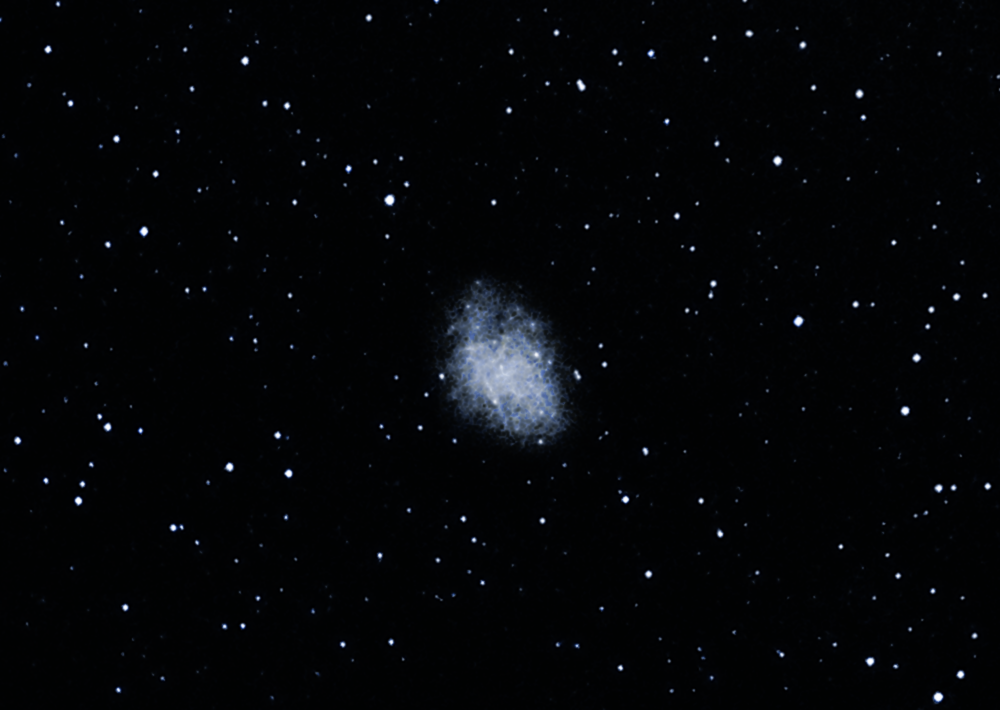
M1 – Crab Nebula – 9exp of 240sec with Qhy8 camera
I compared pictures of the same objects taken with my Orion 102ED refractor, and not only the images are much brighter, but they capture many more fine details with the 8″ astrograph.
The Full Width Half Maximum (FWHM) of stars is significantly better with the 8″ astrograph as well (even though not taken with the same Camera – Canon XTi with the 102ED, and Qhy8 with a larger pixel size for the 8″ astrograph).
The comparison stops there – the Orion 102ED refractor is a very versatile instrument, that is very easy to use (no collimation, no significant cool down time for the optics), and the 8″ Astrograph is not so much for beginners and is dedicated to deep sky astrophotography. So far I am very satisfied with the 8″ astrograph – it is a telescope fun to use – and of great quality / price ratio.
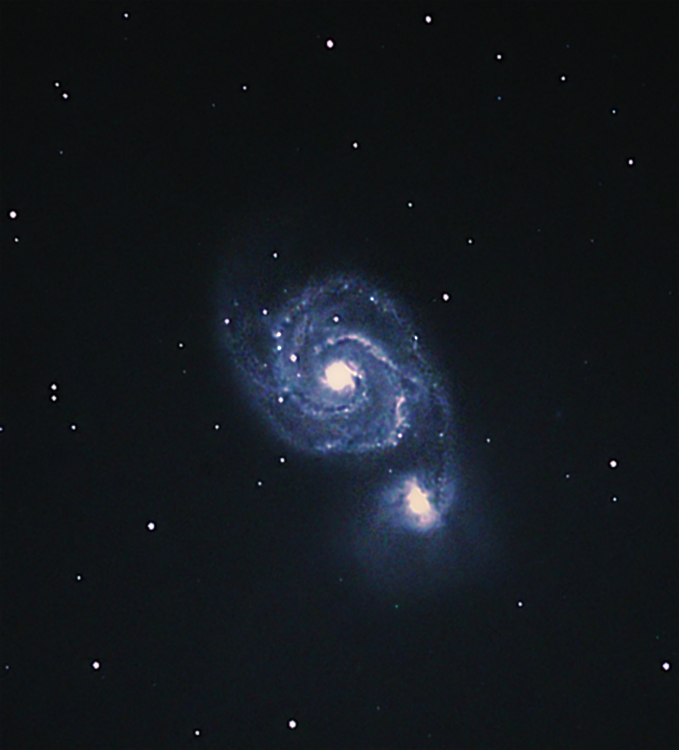
M51 in light polluted sky with Astronomik CLS CCD Filter
Posted in Astrophotography, Deep sky objects on May 3, 2010
This picture of M51 was shot in San Bruno, CA, near the airport.
Telescope: Celestron 9.25″ SCT with Celestron f.d 6.3 corrector / reducer
Camera: QHY8 CCD cooled down at approximatively -40C
Filter: Astronomik CCD CLD
Composite of 6 images of 360sec and 17 images of 240sec.
Software: Photoshop CS4 and NeatImage. I applied high pass filters to enhance contrast in the Galaxy spirals and use Astroart deconvolution to enhance details.
My new camera QHY8 is really amazing – small in size, very easy to use, with a large CCD sensor, and so few noise that I don’t need to shoot each time dark frame. In fact the noise is so low I barely notice the difference when calibrating with Dark frames.
I am always in the quest of improving my deep sky imaging and battling with light pollution. Many nights, the best magnitude I can visually see is between 3 and 4… The skyglow of the city, San Franciso airport, and close caltrain station surround me… I tried different ways to improve contrast by using different light pollution filters and narrow band filters..
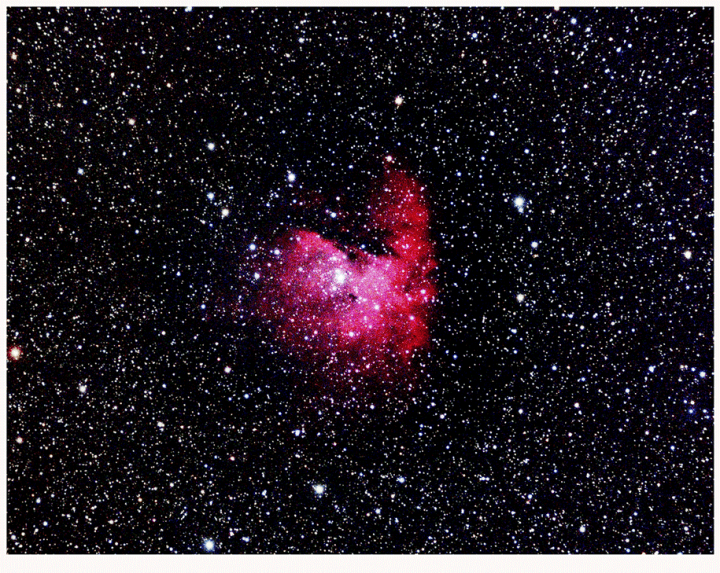
I am impressed with the performance of the Astronomik CLS CCD filter. It really reduces the light pollution, filtering the city lights, but let critical wavelengths such as OIII passing through. I was able to compare with other filters such as the Orion Skyglow photographic filter, and even through the Orion filter allowed me to take nice pictures (see the Pacman nebula with an Orion 102ED, Orion Skyglow filter, and Star Shoot Pro II), the Astronomik filter blocks light pollution to a greater extent and allowed me to do exposures of +6 minutes even with short focal ratio (f/d 4), and this without saturating the image.
Mars in early March 2010
Posted in Planets on March 9, 2010
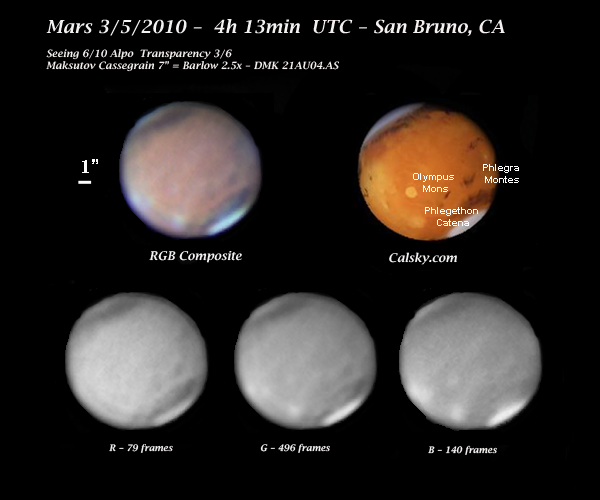
This is probably my best photography of Mars even though it does not exhibit the side of mars with the most features. The seeing was great for my location (Alpo seeing 6/10). Mars was quite high in the sky. The conditions were as good as for the shot I took in November. Orographic clouds over Olympus Mons can be seen, and as well as albedo features such as Phlegra Montes, Phlegethon Catena and Amazonis Planitia. Picture taken at roughly f/d 40 using a 2.5x Siebert optics barlow with DMK B&K Camera – about 1,500 rgb frames – each frane between 1/10 and 1/15 sec of exposure.
For those who are wondering why it is possible to capture (when the seeing is great…) details that are at or sometime far below Dawe’s limit – look at the excellent article from Damien Peach on this topic, explaining why Dawe’s limit is not really applicable to extended objects (planetary disk) with high contrast features.
Saturn, Rhea and Tethys – February 2010
Posted in Astrophotography, Planets on March 3, 2010
Between two rainfalls – I was able to take this picture of Saturn with my Maksutov Cassegrain 7″ at focal plane f/d 15 with my DMK B&W camera. This is a composite picture from about 1100 RGB frames.
Notice from left to right two of Saturn’s satellites: Rhea (mag 9.9) and Tethys (mag 10.3). Cassini’s division is guessed but not very obvious since the rings have a low inclination. – The C ring is hinted on the left and right portion of the disk. Disk diameter is 19″.
Saturn is more challenging to image because of its low surface magnitude. On the Red channel I had to shot at a speed as low as 1/9 sec by image. Just finishing up shooting the blue channel, and clouds came over! Next time I’ll try to image at f/d 22 using a 1/5x barlow to bring more details.
Seeing: 4/10
Transparency: 2/6 (Full moon)
Shot on 2/28/2010 at 1.10am PST

Mars opposition – February 2010
Posted in Astrophotography, Planets on February 15, 2010
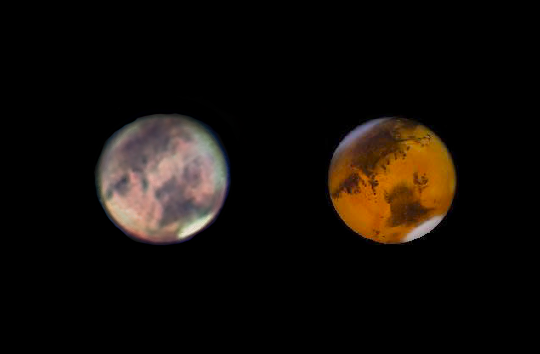
I was able to observe Mars this week end – after weeks and weeks of cloudy sky and rain. The seeing (between 4/10 and 5/10 on ALPO scale) was not as great as in November but I am still very pleased with the result I got in average seeing condition with my Orion Maksutov-Cassegrain 7″ – a mass production telescope I bought for less than $1,200 – and with my black and white Imaging source DMK camera.
Apparent diameter: 13.4″
Mars on 2/14/2010 at 00.43 AM PST – RGB Composite
I used registax 5 to combine about 2,000 rgb frames, and the following software : Photoshop CS4, Focus magic, and sharpener pro 3.0.
I used a x2.5 Siebert optics barlow – and the picture was taken at focal plane at approximatively f/d 40.
Calsky.com rendition of Mars for same date / time is on the right.
________________________________________________________
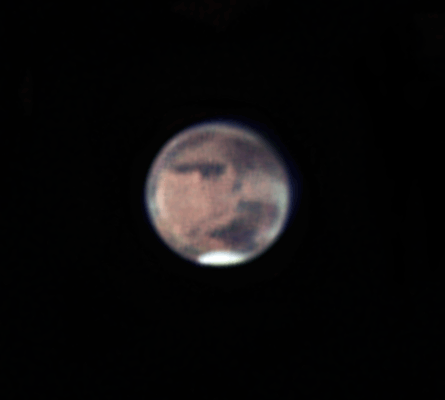
Mars – 02/13/2010 at 22.33 PST – RGB Composite
____________________________________________________________
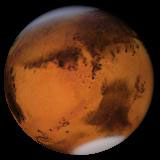
Rendition of Mars on CalSky.com for the same date and time.
_____________________________________________________________
Red Channel Green Channel Blue Channel


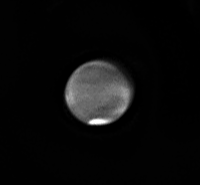
Mars : tweaking my planetary imaging set up – November 2009
Posted in Articles, Astrophotography, Planets on December 5, 2009
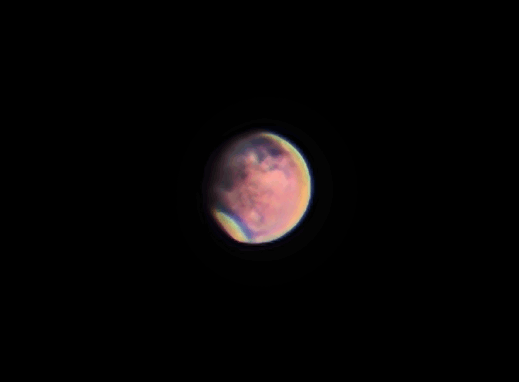
Taken on 11/26/2009 between 3am and 5am at San Bruno, CA. Seeing: 6/10 (Alpo scale) – Transparency: 3/6 -Wind < 5Mpmh
Here are new pictures of Mars, shot at the end of November 2009. At this time, the disc was about 9.5″of diameter. For such a small target I had to tweak my planetary imaging set up to get better results. On the other hand, Mars is at a fairly high altitude, making it easier to deal with turbulence. There were few chromatic distortions (usually there when objects are lower on the horizon – e.g. for Jupiter in the 2009 opposition at my latitude).
Telescope: Orion Maksutov Cassegrain 7″ on Atlas Mount
Camera: DMK Imaging Source B&W with RGB Filters
Barlow: from Siebert optics – this is an excellent barlow that can be used for 1.5x, 2.5x or 3.5x power magnification. Even though the Maksutov is at f/d 15, a barlow is necessary to reach the maximum resolution. Given the space between the camera and the barlow due to the RGB filter wheel I estimate the “true” magnification I used this night to be over 2.5x, which brings the pixel resolution at less than 0.2″ by pixel with the DMK Camera.
Processing: Registax V5 (Frame combinations), Maxim DL5 (initial RBG alignment), Photoshop CS4 and Nik Sharpener Pro 3 for final image processing.
Mars – 11/26/2009 – 4.24AM – RGB composite (see green and red channel below)
____________________________________________________
Red channel : 4.24AM PST Green channel: 4.18 am PST
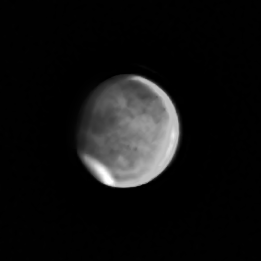
_____________________________________________________
Two more pictures, taken respectively by 3.44AM and 3.53AM PST
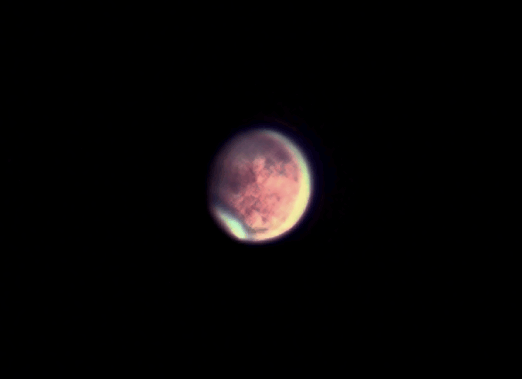

______________________________________________________
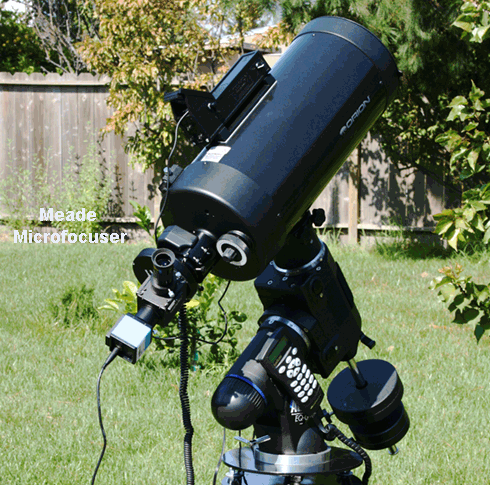
Some notes about the planetary imaging set up: I used the same Planetary set up as explained in this post, but in addition, I added a Meade Microfocuser to the configuration (Meade #1209 Zero Image-shift Microfocuser for Schmidt-Cassegrain).
I removed rhe flip mirror for increased rigidity and alignment of the camera body and filter wheel.
The space gained by removing the flip mirror allows having a reasonable distance between the barlow and the camera body.
When removing the flip mirror, it becomes indispensable to use the Microfocuser because you can focus without moving the primary mirror. Which means Mars stays in the field of view instead of jumping around when you focus with the maksutov cassegrain focuser. Otherwise you need a flip mirror to re-center the planet after focus: the field of view of the DMK camera is very small and you easily move the planet “out of target” when focusing.
In addition, the electric microfocuser allows a fine grain focus very hard to achieve with the manual focuser at the back of the Maksutov Cassegrain OTA. When doing planetary imaging at high F/D it is a must-have accessory…
Wide Field Pictures at Joshua Tree, CA – October 2009
Posted in Astrophotography, Deep sky objects on November 11, 2009
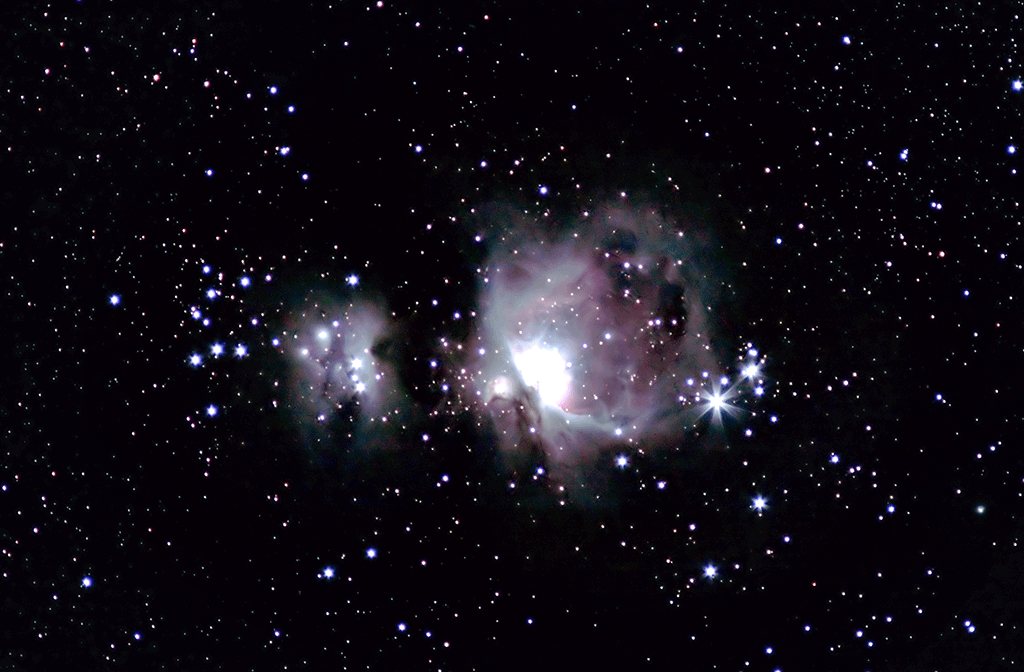
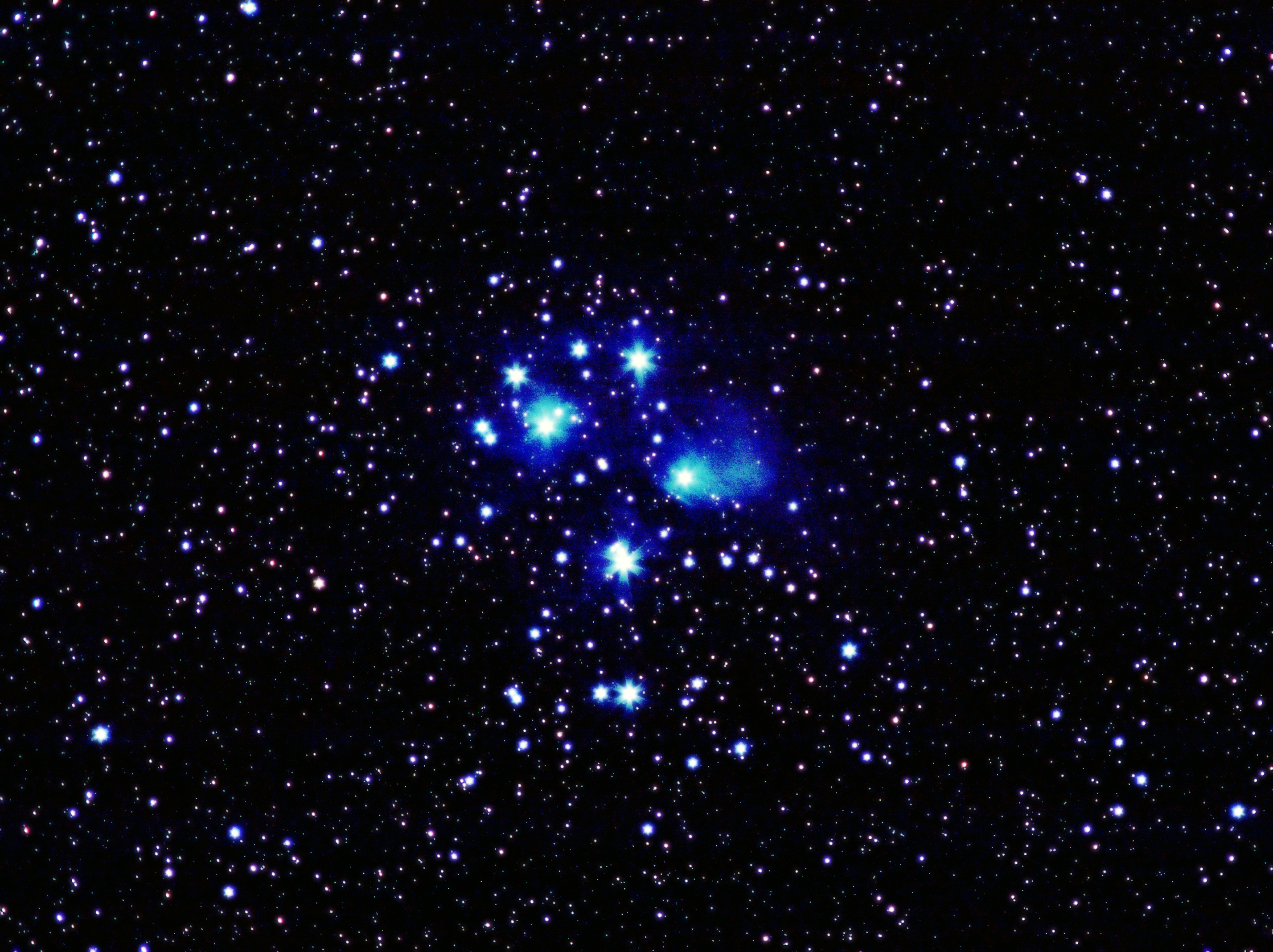
I recently bought a used Soligor Teleobjective lens on eBay for about $40 (!) and tried it out for Wide field astrophotography with my Canon Digital Rebel XTi (unmodified camera).
The Soligor is a 200mm F/D 3.5 Lens for 35mm SLR cameras. The Teleobjetive is lightweight – but gives impression of being very solid.
To use it with a Canon EOS Digital Camera you need an adapter that includes a lens.
Using an FD to EOS adapter usually extends the focal – in my case by 25% from 200mm to 250mm.
I took the following pictures at Joshua Tree, CA – under quite a dark sky on the 25th of October 2009.
The Lens was stopped at F/D 4. The Camera and Teleobjective were mounted on an Orion Onyx 72ED and an Orion Atlas M0unt.
Coma is still visible at the edge of the field. However, I am quite happy with the result given the cost of the lens, especially comparing it to the cost of a brand new Canon teleobjective …
Processing: MaxIm DL 5, Photoshop CS4, and Neat Image.
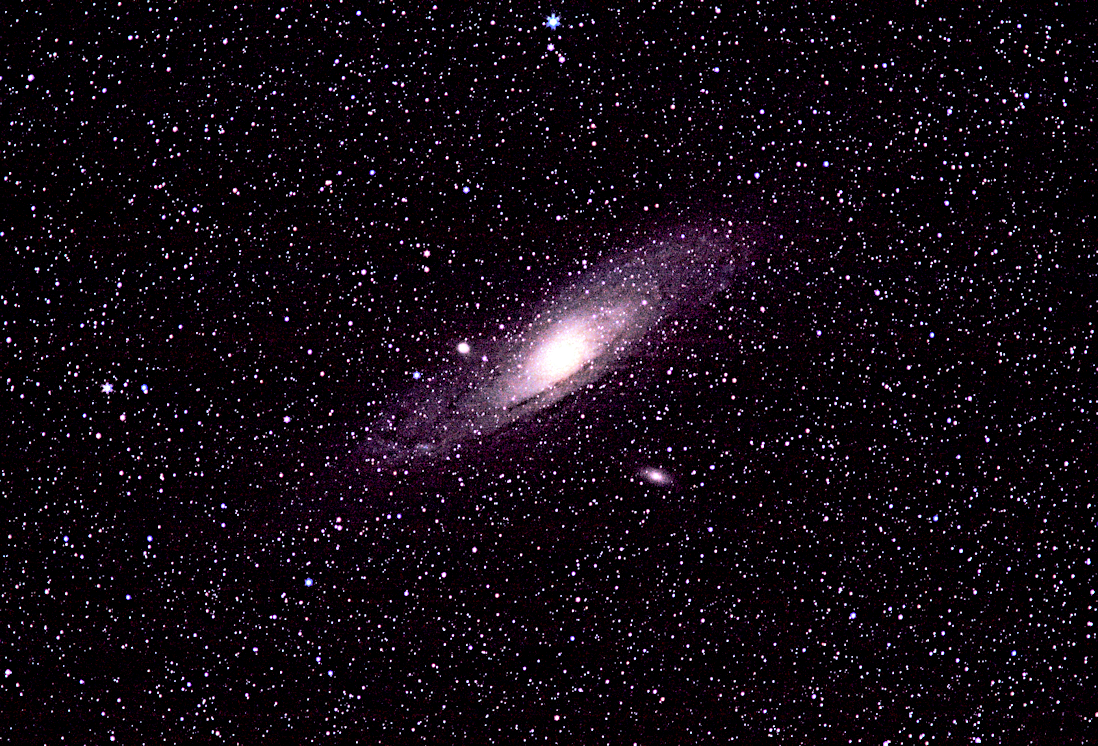
M31 – on 10/25/2009 – Soligor 200mm at F/D 4 – Digital rebel: 9 exposures of 104 sec.

M42 – 10 exposures of 104 sec – Soligor 200mm
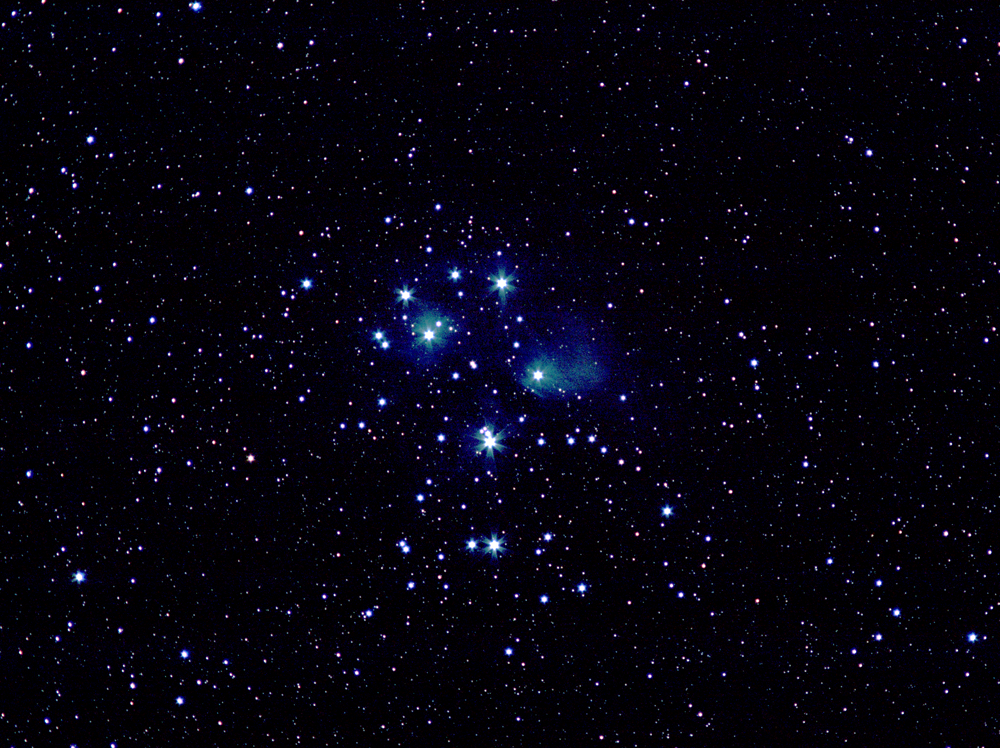
Pleiades – 8 exposures of 104 sec – Soligor 200mm and Digital Rebel XTi
Jupiter and a Joshua Tree after Sunset – 18/50mm Zoom – Canon XTi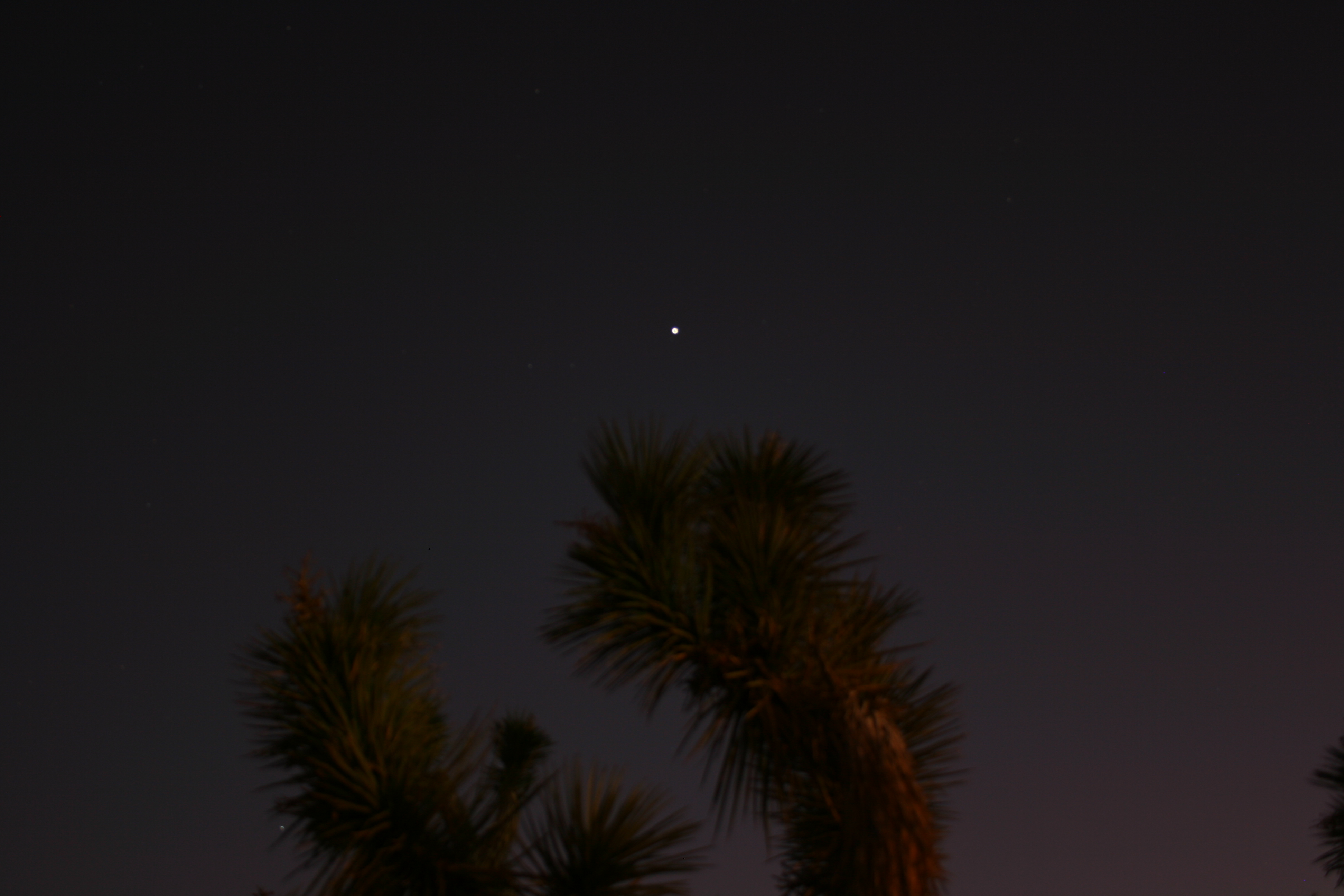
 Astrophotography in Urban Environment